Why More East Texas Farmers Are Rethinking How They Spray
There is a quiet revolution happening across pastures, hayfields, and crop rows in Tyler TX and the surrounding communities. Farmers who once relied on heavy ground rigs or expensive manned aircraft for farm spraying services are discovering a smarter, faster, and more precise alternative—drone technology. We have watched this shift firsthand, and our passion is helping everyday landowners gain access to the same professional farm spraying services that large-scale operations have enjoyed for years. Whether you manage fifty acres of coastal bermuda or several hundred acres of row crops, the way your land gets treated matters. In this article, we walk you through how modern drone spraying services are reshaping agriculture in East Texas, what makes our approach different, and why now is the best time to explore cost-effective farm spraying for your operation.
The Real Problem with Traditional Farm Spraying Services in Tyler TX
For decades, farm spraying services across East Texas followed a predictable pattern. You either hooked a boom sprayer to a tractor and drove row by row, or you called in a crop duster and hoped the wind cooperated. Both methods got the job done—sort of. But they also came with a long list of headaches that most farmers simply accepted as part of the deal.
Ground Rigs and the Toll They Take
Ground-based spraying equipment is the workhorse many of us grew up watching in the field. A tractor pulls a boom sprayer across the acreage, applying herbicide or fertilizer in wide passes. The problem is what happens underneath those tires. Soil compaction from heavy machinery is a well-documented issue that damages root systems, reduces water infiltration, and ultimately lowers yields over time. When you reduce soil disturbance, you protect the very foundation your crops depend on.
Ground rigs also struggle with hard-to-reach areas. Think about those low-lying corners of a pasture that stay wet after a rain, the steep terraces along a creek bank, or the fenced-off sections near livestock pens. Getting a tractor into those spots is impractical at best and damaging at worst. For many landowners near Tyler TX, these inaccessible zones become breeding grounds for invasive weeds simply because traditional equipment cannot reach them.
Then there is the time factor. Hooking up a sprayer, mixing chemicals, driving to the field, making passes, refilling the tank, and cleaning everything afterward can eat an entire day for a relatively modest acreage. For part-time ranchers or farmers who hold off-farm jobs—which describes a significant percentage of operations across East Texas—that lost day is a real cost.
Manned Aerial Spraying and Its Limitations
Aerial spraying by manned aircraft addresses some of the ground rig problems, particularly speed and access. A crop duster can cover hundreds of acres in a few hours without ever touching the soil. However, manned aerial spraying introduces its own set of challenges that are hard to ignore.
First, there is spray drift control. Fixed-wing aircraft fly at higher altitudes and faster speeds, which means droplets travel farther from the intended target. Drift is not just an efficiency problem—it is a liability issue. When herbicide lands on a neighbor’s pasture or a nearby organic garden, relationships and reputations suffer. Farm spraying safety regulations enforced by state and federal agencies exist precisely because drift from manned aircraft has historically caused significant off-target damage.
Second, manned aerial spraying typically requires minimum acreage commitments. If you only need to treat forty or sixty acres, many crop dusting services will either decline the job or charge a premium that makes the per-acre cost unreasonable. That leaves small and mid-size operations—the backbone of East Texas agriculture—underserved and overpaying.
Finally, the scheduling bottleneck during peak season can be brutal. When every farmer in the region needs agricultural spraying services in the same two-week window, getting on a crop duster’s calendar becomes a competitive sport. Delays mean weeds get taller, pests get worse, and the window for effective herbicide application narrows.
These frustrations are exactly why we built Doss Drone Services around a better model—one that delivers professional farm spraying with surgical precision, minimal environmental impact, and pricing that makes sense for real-world East Texas operations.
How Drone Spraying Services Deliver Precision Where It Matters Most
When we tell people we provide drone spraying services, the first question is almost always the same: can a drone really cover meaningful acreage? The answer is an emphatic yes—and it can do so with a level of accuracy that neither ground rigs nor manned aircraft can match.
The Technology Behind Every Flight
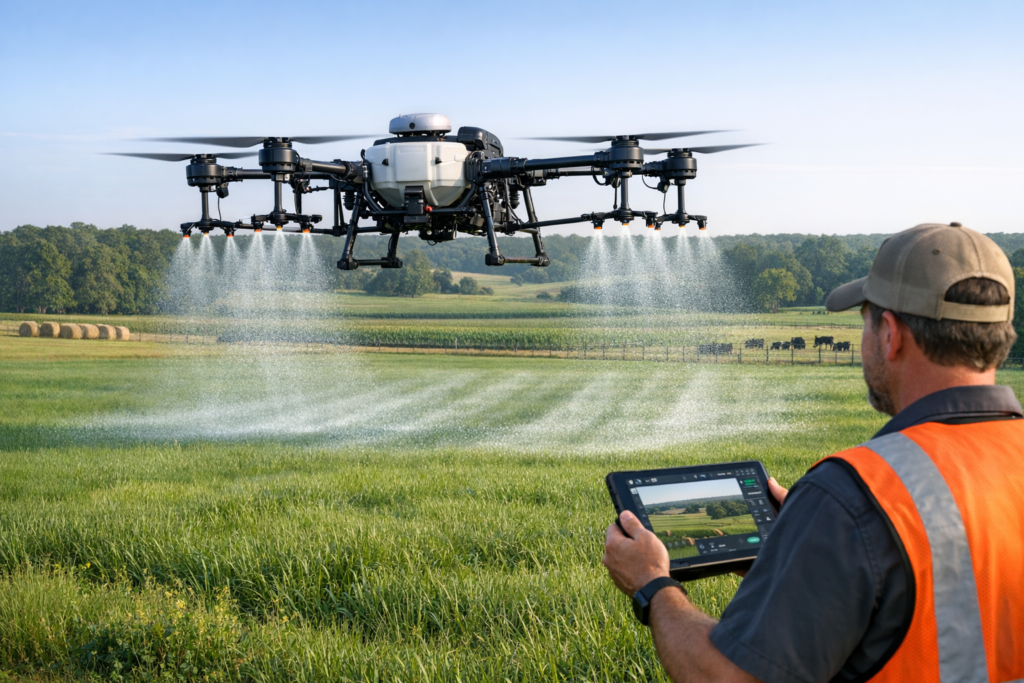
We operate DJI agricultural drones, including the T40 and T20P platforms, which are purpose-built for agricultural spraying services. These are not hobbyist quadcopters. The DJI T40, for example, carries a 40-liter tank and can treat up to 50 acres per hour depending on application rates and dosages. It uses centrifugal atomization nozzles that produce uniform droplet sizes, which is critical for spray drift control and ensuring the product actually lands where it is supposed to.
Each drone is equipped with RTK GPS positioning accurate to the centimeter level. Before a single drop leaves the nozzle, we map the field boundary, set buffer zones around sensitive areas, and program the flight path so the drone follows precise parallel lines with consistent overlap. The result is efficient field coverage that eliminates the skips and double-applications common with manual passes.
Our crop spraying services also leverage terrain-following radar. East Texas is not flat Kansas prairie—our fields roll, dip, and slope. The radar system keeps the drone at a constant height above the canopy, typically between six and ten feet, which maintains uniform application rates and dosages even on uneven ground. This low-altitude operation is one of the biggest advantages over traditional aerial spraying because it dramatically reduces drift and keeps product on target.
Every flight is managed by licensed FAA Part 107 pilots on our team. We do not subcontract to hobbyists or cut corners on certification. Our licensed FAA Part 107 pilots understand airspace regulations, weather limitations, and the operational protocols that keep every mission safe and legal. We also stay current with farm spraying safety regulations at both the state and federal level, so our clients never have to worry about compliance.
Weed Control Spraying with Surgical Accuracy
Weed control spraying is one of the most common requests we handle, and it is where precision spraying truly shines. Invasive species like bahiagrass, broomweed, ragweed, and various thistles plague pastures and hayfields throughout Tyler TX and the broader region. Traditional methods often result in over-application because the operator cannot easily adjust on the fly. With our drone systems, we dial in the exact herbicide application rate recommended by the product label and the agronomist’s prescription, then let the GPS-guided flight path do the rest.
This precision matters for two reasons. First, you use less chemical, which translates to cost-effective farm spraying. When every ounce of herbicide hits its mark instead of drifting into the tree line, your cost per acre drops. Second, you practice environmentally responsible spraying by minimizing off-target exposure to waterways, wildlife habitat, and neighboring properties. Weed control spraying does not have to be a blunt instrument, and our approach proves it.
We have treated everything from ten-acre horse pastures inside city limits to 300-acre cattle operations along FM roads south of Tyler TX. In every case, the targeted precision of drone spraying services meant the landowner saw better weed suppression with fewer callbacks and lower total chemical cost.
Beyond Weeds—Pasture, Hayfield, and Broadacre Applications Across East Texas
While weed control spraying gets a lot of attention, our agricultural spraying services extend well beyond herbicide application. The versatility of drone technology opens doors that many East Texas landowners have not yet considered.
Pasture Spraying and Hayfield Spraying
Healthy pastures and productive hayfields are the economic engine of East Texas livestock operations. Pasture spraying to control broadleaf weeds, brush encroachment, and invasive grasses is essential for maintaining forage quality and carrying capacity. We handle pasture spraying jobs across Smith County and well beyond, treating bermudagrass, bahiagrass, and fescue stands with the appropriate selective herbicides.
Hayfield spraying follows a similar logic but often involves tighter timing windows. Hay producers need weeds knocked back before the first cutting, and delays can mean lower-quality bales and reduced market value. Because our drone spraying services require minimal setup time—we can be airborne within minutes of arriving on site—we help hay producers hit those critical windows even when schedules are tight. Hayfield spraying with drones also avoids the wheel tracks and crop damage that ground rigs inevitably leave behind, preserving yield across the entire field.
Pasture spraying and hayfield spraying together represent the majority of our work during spring and early summer. The feedback we hear most often from clients near Longview TX farm spraying jobs and Palestine TX farm spraying projects is simple: “I wish I had done this sooner.”
Fertilizer Application and Broadacre Spraying
Fertilizer application is another area where drone technology excels. Liquid fertilizer blends—whether urea-ammonium nitrate solutions, micronutrient foliar feeds, or humic acid treatments—can be applied with the same centimeter-level accuracy as herbicides. We work with landowners and agronomists to match application rates and dosages to soil test recommendations, ensuring every gallon of product delivers maximum return.
For larger properties, broadacre spraying with drones is increasingly practical. Advances in battery life and tank capacity mean our DJI agricultural drones can handle broad-acreages efficiently, with rapid turnarounds between loads. Broadacre spraying projects benefit from the same precision spraying advantages—less drift, less waste, less soil compaction—scaled up to meet the demands of bigger operations.
Fertilizer application by drone also opens possibilities for split applications and variable-rate treatments that would be logistically painful with ground equipment. If a soil map shows one section of the field needs more nitrogen than another, we adjust the flight plan accordingly. That level of customization is what separates modern agricultural spraying services from the one-size-fits-all approach of the past.
East Texas farm spraying is evolving, and fertilizer application is a big part of that story. Whether you run cattle near Longview TX or grow hay outside Palestine TX, drone-applied fertilizer can improve your bottom line while keeping your soil health headed in the right direction.
What to Look for in Farm Spraying Contractors—And Why We Do Things Differently
Not all farm spraying contractors are created equal, and the rapid growth of the drone industry means new operators are entering the market regularly. As someone who depends on these services for your livelihood, you deserve to know what separates a professional operation from a weekend hobbyist with a spray tank strapped to a consumer drone.
Credentials, Equipment, and Accountability
Start with credentials. Any legitimate provider of farm spraying services in East Texas should employ licensed FAA Part 107 pilots and carry appropriate liability insurance. Ask to see certificates. At Doss Drone Services, we are transparent about our certifications because we believe trust is earned through documentation, not just promises.
Equipment matters just as much. Professional farm spraying demands commercial-grade platforms like the DJI T40 or T20P—machines designed for sustained agricultural use with redundant safety systems, calibrated nozzles, and reliable GPS guidance. Consumer-grade drones repurposed for spraying lack the tank capacity, flight stability, and spray drift control technology needed for consistent, safe results.
Accountability is the third pillar. Reputable farm spraying contractors provide detailed flight logs, application records, and before-and-after assessments. These records are not just nice to have—they may be required for certain government cost-share programs and are always useful if questions arise about what was applied, when, and at what rate. We maintain comprehensive records for every project, giving our clients peace of mind and a paper trail they can rely on.
Understanding Cost-Effective Farm Spraying
Price is always a consideration, and we understand that. But cost-effective farm spraying is about more than the lowest bid. It is about total value—how much product you actually need, how accurately it gets applied, how much rework or retreatment is required, and how much collateral damage occurs to soil, non-target vegetation, and waterways.
When you factor in reduced chemical usage from precision spraying, zero soil compaction, minimal crop damage, and the ability to treat hard-to-reach areas that would otherwise go untreated, drone-based farm spraying services consistently deliver the best return on investment for small and mid-size operations. We have seen clients save 15 to 30 percent on total herbicide costs simply because precision application eliminated the waste inherent in traditional methods.
Environmentally responsible spraying also carries long-term economic benefits. Healthier soil biology, cleaner water runoff, and stronger forage stands all compound over seasons and years. Professional farm spraying is an investment in the future productivity of your land, not just a line item on this year’s budget.
Farm spraying services in East Texas should work for you—not the other way around. Whether you need pasture spraying on a small tract near Tyler TX, hayfield spraying ahead of first cutting, weed control spraying on overgrown fence lines, or fertilizer application across broad-acreages, the right partner makes all the difference.
Ready to See What Smart Spraying Can Do for Your Land?
We have covered a lot of ground—from the limitations of traditional methods to the precision, efficiency, and environmental advantages that modern drone spraying services bring to East Texas farms and ranches. The bottom line is straightforward: farm spraying services have entered a new era, and the technology is accessible, affordable, and proven.
Here is what we want you to take away:
– Drone-based crop spraying services eliminate soil compaction and reach hard-to-reach areas that ground rigs cannot.
– Precision spraying reduces chemical waste, lowers per-acre costs, and supports environmentally responsible spraying practices.
– Professional agricultural spraying services backed by licensed pilots, commercial-grade DJI agricultural drones, and strict adherence to farm spraying safety regulations deliver results you can trust.
– Whether your operation is near Tyler TX, Longview TX, Palestine TX, or anywhere across East Texas, cost-effective farm spraying is within reach.
At Doss Drone Services, we have built our business around one simple belief: every landowner deserves access to professional farm spraying that is precise, reliable, and fairly priced. We would love the chance to show you what that looks like on your property.
Reach out to us today at dossdronetx.com to request a free consultation or get a quote for your next spraying project. Let us put this technology to work for your farm.