How Aerial Application Drones Are Changing Day-to-Day Farming in Jacksonville TX
Our team has watched a quiet revolution take shape over the fields of Jacksonville TX. Instead of tractors pulling booms or manned airplanes buzzing low over corn and hay, more and more fields are being treated by aerial application drones. These precision agriculture tools are giving landowners, farmers, and ranchers a way to spray faster, safer, and more accurately than many traditional methods.
At Doss Drone Services, our passion is using aerial drone spraying to solve everyday problems in crop protection. We see how weather windows are shrinking, labor is tight, and chemical costs keep rising. Aerial application drones help us hit narrow spray windows, reduce waste, and protect sensitive areas around homes, ponds, and timber. In this article, we want to walk you through how this technology works, why it fits East Texas agriculture so well, and what it looks like to put it to work on your own ground.
From Planes and Booms to Precision: What Aerial Drone Spraying Really Delivers
For decades, aerial pesticide application meant calling in a spray plane or helicopter, while ground rigs handled the rest. That approach still has a place, especially on huge, uniform tracts. But in and around Jacksonville TX, fields are often irregular, hilly, wooded, or broken up by ponds and creeks. This is where aerial drone spraying really shines and where aerial application drones are quietly transforming farm spray operations.
We use agricultural drone application systems to treat fields that are too wet for tractors, too small or obstructed for planes, or too sensitive to risk excessive drift. Our crop spraying drones can take off near the field, fly low and slow, and follow tight boundaries with RTK GPS mapping. Instead of trying to fit your field into a one-size-fits-all spray method, we tailor the aerial drone spraying to match your exact terrain and crop layout.
Why Drones Fit East Texas Fields So Well
Our part of East Texas is full of hardwood draws, creek bottoms, ponds, and oddly shaped pastures. Traditional broadacre spraying with a large boom rig often means:
– Ruts and compaction in wet ground
– Missed corners and skipped patches
– Overlaps that waste product
– Difficult turns around trees, fences, and homes
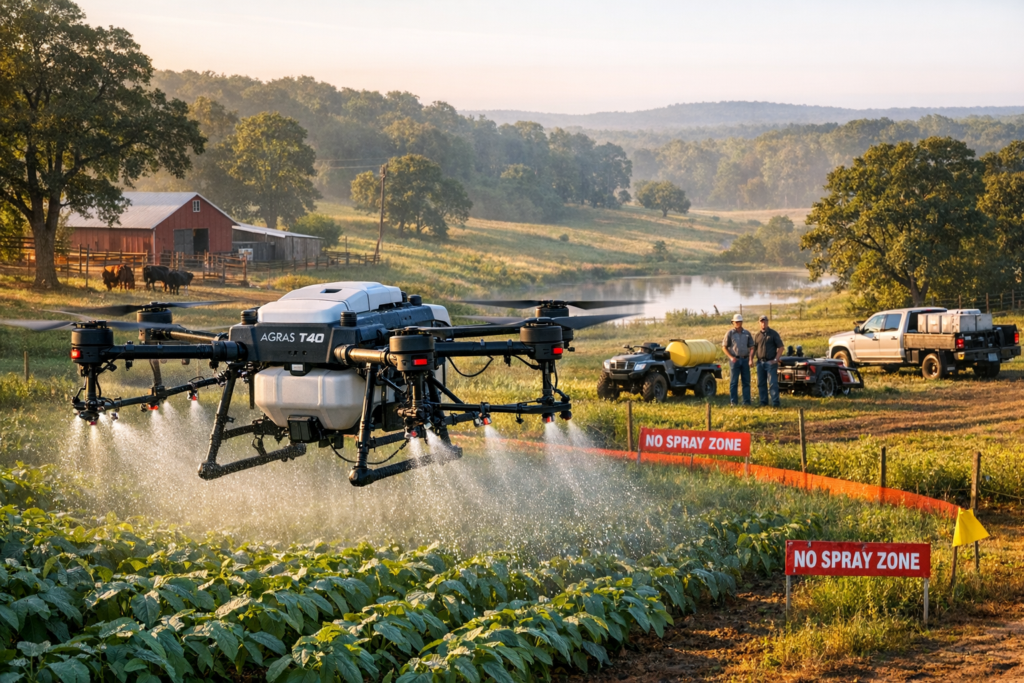
Aerial application drones let us fly right over those obstacles. With precision agriculture drones like the DJI Agras T40, we can:
– Follow field edges within inches using RTK GPS mapping
– Maintain a constant height and speed to improve droplet size and coverage
– Turn tightly at the headland without driving on the crop
– Safely stay clear of homes, barns, livestock pens, and no-spray areas
Our aerial drone spraying services also help protect soil structure because we are not running heavy equipment across saturated ground. That matters for hay meadows, improved pastures, and row crops that can suffer long-term yield loss from compaction.
From Blanket Coverage to Targeted Spraying
In the past, crop protection often meant blanket coverage: spray the whole field at one rate and hope for the best. With agricultural drone application, we are shifting toward precision agriculture, where we put the right product in the right place at the right time.
Using flight planning software and field maps, we routinely provide:
– Spot spraying / targeted spraying on weedy patches or problem zones
– Variable rate application to adjust rates for different soil types or weed pressures
– Careful attention to buffer zones and no-spray areas around ponds, streams, and neighbor boundaries
Instead of guessing, we rely on GPS-guided routes and accurate terrain data so our crop spraying drones only cover what is needed. That reduces chemical use, improves crop protection, and makes aerial pesticide application more sustainable for the long term.
Inside the Technology: How Precision Agriculture Drones Actually Work
When we show up on a property near Jacksonville TX, many landowners, farmers, and ranchers are surprised at how sophisticated our aerial application drones really are. These are not hobby drones; they are purpose-built, commercial aircraft designed for agricultural drone application under FAA Part 107 and FAA Part 137 agricultural operations.
A core workhorse in our fleet is the DJI Agras T40. This precision agriculture drone is engineered for aerial drone spraying and granular spreading. Its design, sensors, and control systems let us execute complex spray plans in a safe, repeatable way, even across uneven East Texas terrain.
The Role of DJI Agras T40, Payload, and Flight Planning
Our DJI Agras T40 units combine high spray drone payload capacity with advanced guidance and safety features. That means we can keep the drone in the air longer between refills and cover more acres per hour on larger jobs.
Key features we rely on include:
– Generous spray drone payload capacity so we can carry enough herbicide and fertilizer application mixes for efficient field coverage
– RTK GPS mapping capability, which gives us centimeter-level accuracy in navigation
– Obstacle detection sensors that help the UAV sprayer operate safely near trees, powerlines, and terrain changes
– Flight planning software that turns your field boundaries into precise flight paths and spray patterns
We typically start by importing or creating a detailed field boundary using RTK GPS mapping. Once we define the treatment zones, buffer zones and no-spray areas, and any special instructions (for example, extra passes on weedy corners), we program the agricultural drone application in the flight planning software. The UAV spraying routes are then flown automatically, with one of our FAA Part 107 certified pilots supervising every step.
Droplet Size, Coverage, and Drift Reduction
Good aerial pesticide application is not just about flying over a field and turning on the pump. The real quality comes down to droplet size and coverage. Our DJI Agras T40 systems allow us to fine-tune nozzle setup, pressure, and flow rate so we match the product label and your crop’s needs.
We pay close attention to:
– Droplet size and coverage: Smaller droplets improve coverage but may increase drift risk; larger droplets reduce drift but may reduce leaf coverage. We strike this balance based on product labels and field conditions.
– Drift control / drift reduction: We adjust flight height, speed, and nozzle type to reduce off-target movement. Many jobs involve specific drift reduction agents to keep the product where it belongs.
– Label-compliant application: Every aerial drone spraying mission is designed to match label directions on rate, carrier volume, and environmental restrictions.
Because precision agriculture drones fly at lower speeds and lower altitudes than many conventional aircraft, we have more control over application quality. We can pause, resume, or modify the UAV spraying plan in real time if winds shift or conditions start to change.
Real-World Use Cases: How East Texas Aerial Spraying Services Help Local Operations
In and around Jacksonville TX, we have seen nearly every kind of operation benefit from aerial application drones. From row-crop producers to hay growers to timberland owners, our East Texas aerial spraying services are built around real-world needs, not just technology for technology’s sake.
Our approach starts with a simple question: what problem are we solving? Then we tailor our aerial drone spraying strategy—products, timing, and technique—to match your specific crops, weeds, and land layout. Because our team lives and works here, we understand local weed spectrums, rainfall patterns, and the realities of trying to farm in narrow weather windows.
Crop Protection, Herbicides, Fertilizer, and More
Some of the most common agricultural drone application projects we handle include:
– Herbicide and fertilizer application on hay meadows and improved pastures, especially when the ground is too wet for tractors
– Crop protection for row crops where targeted spraying controls specific weed outbreaks or disease hotspots
– Broadacre spraying / large-acreage spraying for landowners, farmers, and ranchers who want consistent coverage without tying up their own equipment
– Aerial pesticide application for insect control where timing is critical and weather windows are short
By combining crop spraying drones with precise maps and product recommendations (often from your agronomist or consultant), we deliver consistent, repeatable application across every acre. We can quickly move from one tract to another, which is especially helpful when you farm ground scattered across Jacksonville, Longview, and Palestine.
Spot Spraying, Variable Rates, and Aquatic Vegetation Control
Not every job calls for blanket coverage. One of the strengths of aerial application drones is the ability to perform spot spraying / targeted spraying and variable rate application. We frequently help clients with:
– Spot spraying of thistle patches, johnsongrass clumps, or brushy draws without treating the entire pasture
– Variable rate application in fields that have known fertility zones, applying more product where yields justify it and less where they do not
– Aquatic vegetation control in ponds and small lakes, where UAV spraying can treat water surfaces without putting a boat in the water
For aquatic vegetation control, aerial drone spraying is particularly helpful on ponds with limited access or steep banks. We follow strict label-compliant application standards and honor buffer zones and no-spray areas around sensitive shorelines, docks, or neighbors’ properties. Our goal is always effective crop protection and vegetation management with the least environmental impact.
In addition, when we provide drone spraying services in Longview and Palestine, we bring that same attention to detail. Whether you manage multiple hay fields across counties or timberland tracts with encroaching brush, our East Texas aerial spraying services are designed to save you trips, labor, and downtime.
Safety, Compliance, and Working with Doss Drone Services in Jacksonville TX
Behind every flight we make with our aerial application drones is a strict commitment to safety and regulatory compliance. Aerial pesticide application is heavily regulated for good reasons: we are dealing with chemicals, airspace, and public safety. Our team treats this responsibility with the seriousness it deserves.
We operate under FAA Part 107 certified pilots and FAA Part 137 agricultural operations approval. That means our pilots, our procedures, and our aircraft meet specific federal requirements to conduct agricultural drone application work professionally and legally.
Regulations, Buffer Zones, and Label Compliance
When we plan an aerial drone spraying job for landowners, farmers, and ranchers around Jacksonville TX, we look beyond just the crop and product. We carefully examine:
– Buffer zones and no-spray areas along property lines, residences, public roads, and waterways
– Weather conditions, especially wind speed and direction, temperature, and inversion risks
– Product labels for required setbacks, droplet size guidance, and drift control / drift reduction measures
Our commitment to label-compliant application means we will sometimes advise delaying or adjusting a job if conditions do not meet safety and legal requirements. That might mean changing a time of day, altering application rates, or selecting a different nozzle configuration to improve droplet size and coverage.
We also brief property owners on what to expect: where we will stage equipment, how we will enter and exit the property, and what safety measures we put in place to keep bystanders and livestock out of treated areas during and after aerial pesticide application.
What It Looks Like to Work with Doss Drone Services
When you contact us for Doss Drone Services aerial application, we follow a simple, transparent process:
1. Field review and goals
We talk through your crop, pasture, or property goals. Are you aiming for weed control, insect control, herbicide and fertilizer application, or aquatic vegetation control?
2. Mapping and planning
We either gather field boundaries from you or map them ourselves using RTK GPS mapping. We mark buffer zones and no-spray areas and design the UAV spraying plan in our flight planning software.
3. Scheduling and setup
We schedule around weather, product availability, and your needs. On the day of service, we arrive with aerial application drones, mixing equipment, and support vehicles, ready to operate efficiently and safely.
4. Execution and monitoring
Our FAA Part 107 certified pilots oversee each mission, monitoring wind, performance, and coverage. We adjust on the fly if needed to maintain safety and label-compliant application.
5. Reporting and follow-up
After the job, we can provide application maps and summaries so you know exactly where each aerial drone spraying pass occurred. We follow up to discuss results and next steps for ongoing crop protection.
Doss Drone Services aerial application is built around long-term relationships. We want our East Texas aerial spraying services to be a reliable part of your annual farm plan, not just a one-time fix. That is why we continue to invest in better precision agriculture drones, updated DJI Agras T40 units, and advanced flight planning software as the technology evolves.
If you would like to learn more about the broader world of farm drones and precision agriculture, one useful starting point is the FAA’s UAS resources page at https://www.faa.gov/uas, which explains regulations and safety considerations for UAV sprayer operations.
We believe aerial application drones are not just a fad; they are becoming a standard tool in the precision agriculture toolbox. Around Jacksonville TX and across East Texas, we see them helping landowners, farmers, and ranchers make better use of their time, their inputs, and their land. If you are ready to see how aerial drone spraying, variable rate application, and targeted crop protection can work on your acres, we are here to help.
To schedule Doss Drone Services aerial application or to request a field review anywhere near Jacksonville, or to ask about drone spraying services in Longview and Palestine, contact us today at https://dossdronetx.com/.