Why More Landowners in Palestine TX Are Looking to the Sky for Seeding Solutions
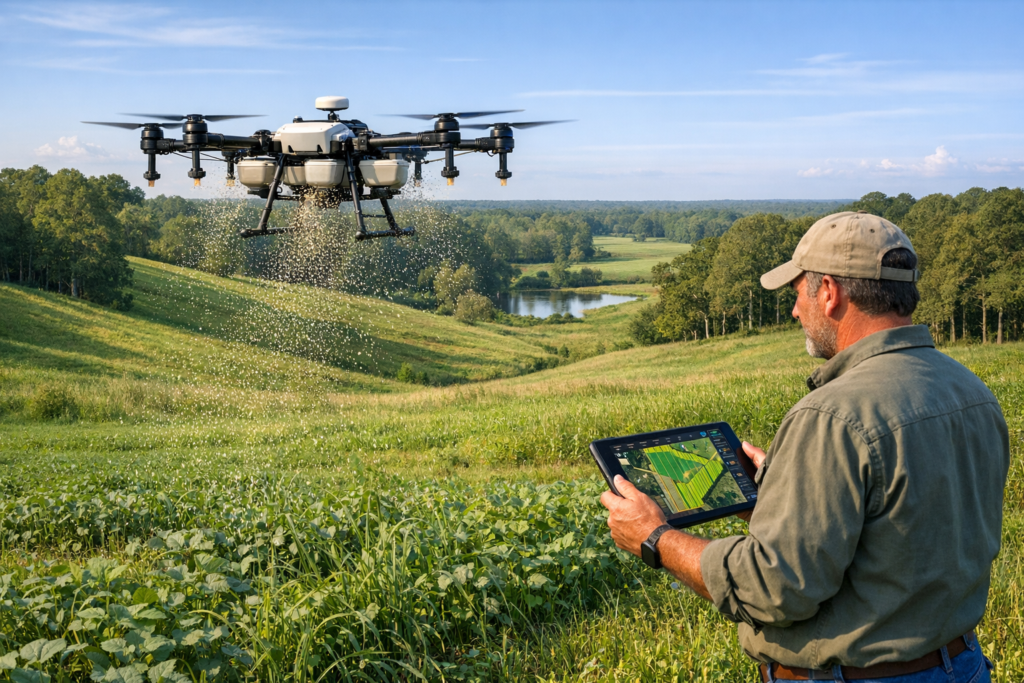
If you have ever tried to drive a tractor across a rain-soaked bottomland pasture or wrestle a seed drill up a steep East Texas hillside, you already know the frustration. Traditional ground-based equipment can compact saturated soils, get stuck in muddy creek bottoms, and simply cannot reach every corner of a large property. That is exactly why aerial seeding services have gained so much momentum among ranchers, timber companies, and wildlife managers across our region. At Doss Drone Services, we have watched this shift firsthand. Our team works with landowners throughout Palestine TX and the broader East Texas corridor, deploying purpose-built agricultural drones to broadcast seed precisely where it is needed—without a single tire track left behind. In the paragraphs that follow, we will walk you through exactly how drone seeding works, why it outperforms older methods on difficult terrain, and what you should know before scheduling your first flight.
Aerial Seeding Explained: What It Is, How It Works, and Why Drones Changed the Game
Defining Aerial Seeding in Modern Agriculture
Aerial seeding is the practice of distributing seed across a target area from an airborne platform rather than a ground-based implement. Historically, that platform was a manned fixed-wing airplane or helicopter. While those aircraft can cover thousands of acres in a single day, they come with steep mobilization costs, limited precision, and minimum-acreage requirements that price out many mid-size operations. Drone seeding has rewritten those economics. Today’s agricultural drones carry calibrated hoppers, GPS-guided flight controllers, and variable-rate dispensing systems that let a single FAA-certified drone pilot place seed with sub-meter accuracy. That combination of accessibility and precision agriculture technology is what makes modern aerial seeding services so compelling for landowners in Palestine TX and across East Texas.
The Drone Broadcasting Process Step by Step
When we arrive on a property, we follow a repeatable workflow designed for consistency and accountability:
– We begin with a site assessment and seeding consultation. Using satellite imagery and on-the-ground observations, we evaluate soil conditions, existing vegetation, slope, and drainage patterns.
– Next, we build a GPS flight plan that maps every pass the drone will make, ensuring uniform seed broadcasting across the target zone.
– We calibrate the drone’s dispensing mechanism to the correct seed rate for the species being sown—whether that is a clover blend at eight pounds per acre or a cereal rye cover crop at ninety pounds per acre.
– The drone then executes its mission autonomously, flying precise transects while broadcasting seed at a consistent application rate.
– After the flight, we provide the landowner with a digital coverage map confirming exactly where seed was placed.
This level of precision seeding simply is not possible with a manned aircraft scattering seed from five hundred feet in the air. Drone broadcasting allows us to hug the canopy at fifteen to twenty-five feet, which dramatically improves seed placement accuracy and reduces drift from crosswinds.
Pros, Cons, and Honest Expectations
We believe in transparency. Aerial seeding is not a silver bullet. Because seed is deposited on the soil surface rather than drilled into a furrow, seed-to-soil contact depends heavily on existing ground cover, residue, and weather. On a cleanly grazed pasture or a recently burned field, seed-to-soil contact is excellent and germination rates rival those of conventional drills. On a thick mat of dormant bermudagrass, results can be less predictable unless the field is properly prepared or the timing aligns with adequate soil moisture.
That said, the advantages are significant:
– No-till seeding preserves soil structure and biology.
– Low soil disturbance means reduced erosion on vulnerable slopes.
– Fields too wet or too steep for equipment can still be seeded on schedule.
– Mobilization costs are a fraction of what a manned aircraft charges.
When conditions align and the project is planned carefully, aerial seeding delivers germination and establishment rates that are competitive with—and sometimes superior to—conventional methods, especially on difficult terrain and inaccessible areas where ground equipment would cause more harm than good.
Where Drone Seeding Makes the Biggest Difference: Use Cases Across East Texas
Pasture and Hayfield Seeding
Pasture and hayfield seeding is our most requested service. Across Palestine TX and the surrounding counties, bermudagrass pastures eventually thin out due to drought, overgrazing, or weed pressure. Traditional pasture renovation requires disking, spraying, and drilling—a process that takes the field out of production for weeks and leaves bare soil exposed to erosion. With drone seeding, we can overseed winter annuals like ryegrass or crimson clover directly into a standing bermudagrass sward. The existing turf acts as a living mulch, protecting newly germinated seedlings while maintaining ground cover. The result is improved forage yield without the cost or disruption of a full pasture restoration.
For producers who do need a more aggressive pasture renovation, we often work in tandem with herbicide application. We can schedule a burndown spray—sometimes applied by drone as well, given herbicide and fertilizer compatibility with our platforms—followed by aerial seeding once the existing canopy opens up. This approach pairs low soil disturbance with effective weed control and is one of the most cost-effective seeding strategies available for rangeland and acreage management in East Texas.
Cover Crop Seeding for Soil Health and Erosion Control
Cover crop seeding has exploded in popularity as more producers recognize the agronomic and financial benefits of keeping living roots in the soil year-round. In our part of East Texas, common cover crop species include cereal rye, crimson clover, winter peas, and radishes. The challenge is timing: cover crops need to go in the ground as soon as the cash crop or summer forage is removed, and fall weather windows in East Texas can be narrow. Drone seeding solves this by enabling us to broadcast cover crop seed into standing forage or row crops before harvest, giving the cover crop a head start on germination and establishment.
Cover crops also serve as a front-line tool for erosion control. On sloping fields, disturbed construction sites, and shoreline buffers, aerial seeding places a protective vegetative cover without the ruts and compaction that ground equipment would create. We have seeded steep creek banks, pipeline rights-of-way, and cleared timber tracts around Palestine TX where no other seeding method was practical.
Wildlife Food Plots and Habitat Enhancement
East Texas is deer and turkey country, and wildlife food plots are a major part of land management for hunting leases and private ranches alike. Traditional food plot preparation requires clearing, tilling, and planting—labor-intensive work that demands equipment access to remote openings in the timber. Drone seeding changes the equation entirely. We can fly over wooded openings, power-line corridors, and senderos to broadcast wildlife food plots of iron clay cowpeas, jointvetch, Egyptian wheat, or brassica blends without ever cutting a trail wide enough for a tractor.
Because our drones operate at low altitude, seed placement is precise enough to stay within the boundaries of small, irregular openings—something a manned aircraft simply cannot do. For hunting clubs managing multiple plots across thousands of acres of rangeland and acreage, the time savings alone justify the investment.
The Agronomy Behind Successful Aerial Seeding: Rates, Timing, and Soil Conditions
Getting the Seed Rate and Application Rate Right
One of the first questions we hear during a seeding consultation is, “How do you make sure the right amount of seed goes out?” It is a fair question, and the answer lies in calibration. Before every job, we weigh the seed, measure the flow rate from the hopper at multiple gate settings, and calculate the application rate needed to achieve the target seed rate for the species in question. For example, a perennial ryegrass overseeding might call for twenty-five pounds per acre, while a heavy cereal rye cover crop planting could push ninety pounds per acre.
Our drone’s GPS-guided flight controller tracks ground speed and swath width in real time, adjusting the dispensing rate so that every square foot receives a uniform amount of seed. This is precision agriculture at its most practical—variable-rate application technology adapted for seed broadcasting rather than liquid spraying. If part of a field needs a heavier rate due to thin cover or poor stands, we simply program a higher rate for that zone within the flight plan.
Soil Moisture, Soil Conditions, and Timing Windows
No amount of technology can overcome bad timing. Soil moisture is arguably the single most important variable in any aerial seeding project. Seed that lands on bone-dry ground will sit dormant until rain arrives, leaving it exposed to predation and UV degradation. Conversely, seed broadcast onto saturated, puddled soil may wash away before it can anchor a root.
We monitor soil conditions closely using a combination of local weather station data, on-site soil probes, and regional forecasts. Our goal is to time every seeding flight so that adequate soil moisture is either present at planting or expected within forty-eight to seventy-two hours. In East Texas, that often means scheduling cover crop seeding just ahead of a fall frontal passage or timing a spring pasture and hayfield seeding to coincide with the dependable March and April rain pattern around Palestine TX.
Seed-to-Soil Contact: Limitations and Best Practices
Because drone seeding places seed on the surface, maximizing seed-to-soil contact is critical for strong germination and establishment. We recommend several strategies to improve outcomes:
– Time seedings to coincide with natural hoof traffic from cattle, which presses seed into the soil surface.
– Seed into short or recently grazed pastures where bare ground is visible between plants.
– Use a light drag or roller pass after seeding on fields accessible to a four-wheeler or UTV.
– Choose small-seeded species like clovers and ryegrass that require minimal burial depth—often just light contact with moist soil is enough.
When these practices are combined with proper soil moisture, germination rates from no-till seeding via drone consistently meet or exceed eighty percent in our experience across dozens of East Texas projects.
Why Palestine TX Landowners Choose Doss Drone Services for Aerial Seeding
FAA-Certified Pilots, Local Knowledge, and Custom Seeding Plans
We are not a generic drone company that dabbles in agriculture. Doss Drone Services was built from the ground up around agricultural drone services, and our FAA-certified drone pilots hold Part 107 certifications with additional waivers for operations that demand them. More importantly, we live and work in East Texas. We understand the soils—Cuthbert sandy loams, Woodtell clays, Elrose fine sandy loams—and we know which seed mixes perform best in our climate zone. That local expertise feeds directly into the custom seeding plans we develop for every client.
Whether you manage fifty acres of improved bermudagrass pasture or five thousand acres of native rangeland, we build a plan around your goals, your budget, and your timeline. Our seeding consultation covers species selection, seed rate recommendations, soil preparation guidance, and post-seeding management tips to ensure the best possible germination and establishment.
Cost-Effective Seeding Without Cutting Corners
One of the most common misconceptions about agricultural drone services is that they are expensive. In reality, when you factor in the cost of mobilizing heavy equipment, fuel, operator labor, and the yield lost from soil compaction, drone seeding is remarkably cost-effective seeding. We have helped landowners reduce operating costs by thirty to fifty percent compared to traditional drill seeding on properties where difficult terrain and inaccessible areas made ground equipment impractical.
Our pricing is transparent and acreage-based. There are no hidden mobilization fees, no minimum-acreage requirements that force you to pay for more than you need, and no surprises. For East Texas aerial seeding projects, we typically quote a per-acre rate that includes flight planning, calibration, seed broadcasting, and a post-flight coverage report.
Faster Coverage of Large Acreages, Minimal Downtime
Time is always a factor in agriculture. When a rain window opens, you need seed in the ground now—not next week when the drill operator has an opening. Our drones can cover large acreages quickly, seeding forty to sixty acres per day depending on seed type and terrain complexity. That speed translates to faster coverage of large acreages and the ability to hit tight weather windows that ground crews simply cannot match.
Because drone seeding requires no soil preparation pass, there is zero downtime between deciding to seed and actually putting seed on the ground. We have mobilized for same-week flights on multiple occasions when East Texas aerial seeding clients called with an approaching rain event and open fields ready for cover crop seeding or pasture renovation.
Ready to Put Aerial Seeding Services to Work on Your Land?
We have covered a lot of ground—figuratively and literally. Aerial seeding services powered by modern drone technology offer East Texas landowners a smarter, faster, and more cost-effective path to improved forage yield, healthier soils, and better wildlife habitat. From pasture and hayfield seeding to cover crop seeding and wildlife food plots, drone seeding handles the jobs that ground equipment cannot, reaching difficult terrain and inaccessible areas without compaction, ruts, or erosion.
At Doss Drone Services, our passion is helping landowners in Palestine TX and across the region get more out of every acre. We bring FAA-certified drone pilots, precision agriculture technology, and deep local agronomic knowledge to every project. Whether you need a single wildlife food plot in a remote timber opening or a full-scale pasture restoration across hundreds of acres, we are ready to build a custom seeding plan around your operation.
The next step is simple. Visit us at dossdronetx.com to schedule a free seeding consultation, request a quote, or just ask a question. Let us show you what aerial seeding can do for your land—no tire tracks required.