A Quiet Revolution Taking Root Across East Texas Fields
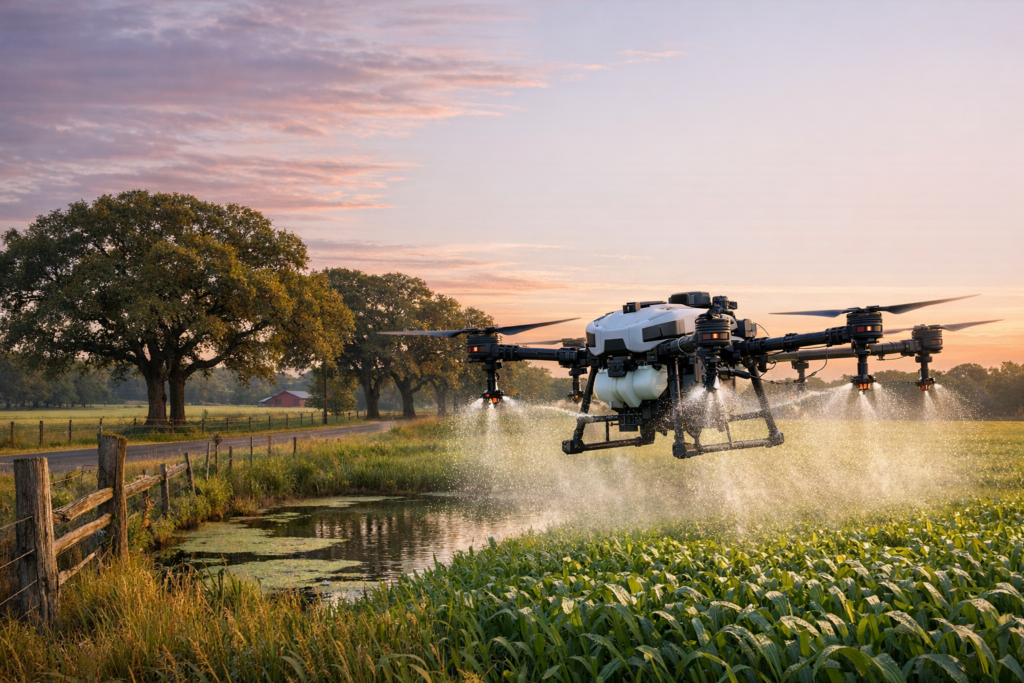
Drive down any Farm-to-Market road near Elkhart TX on a calm spring morning and you might hear something unexpected — a low, steady hum above the treeline. It is not the rumble of an old Ag Cat biplane. It is the sound of drone crop dusting services in East Texas reshaping the way we grow, protect, and profit from the land. At Doss Drone Services, we have witnessed firsthand how this technology is turning skeptical landowners into passionate advocates. From pastures choked with broadleaf weeds to catfish ponds smothered in algae, the problems are familiar. The solution, however, has never been this precise, this affordable, or this safe. In the next several sections, we will walk you through exactly why modern aerial crop dusting with drones is delivering measurable yield gains, how the technology works, whom it serves, and what makes our approach in Elkhart TX different from anything else available in the region.
Why Drone Crop Dusting Services Are Replacing Traditional Methods
For decades, agricultural aviation meant one thing: a manned aircraft swooping low over a field, releasing a cloud of chemical that drifted wherever the wind decided. We respect that heritage — it fed the nation. But the economics, the environmental pressures, and the technology landscape have shifted dramatically. Today, drone crop dusting services offer a smarter path forward, and East Texas landowners are paying attention.
The Cost and Access Problem With Manned Aircraft
Traditional aerial application services typically require a minimum acreage commitment, often 100 acres or more, before a pilot will even ferry an aircraft to your location. For the many farmers and ranchers around Elkhart TX who manage 20 to 80-acre tracts, that minimum has always been a barrier. They either pay a premium surcharge, hire a ground rig that tears up wet fields, or simply skip the application altogether — and watch yields suffer.
Our drone crop dusting services eliminate that barrier entirely. We mobilize quickly, set up on a field edge or county road turnout, and begin spraying within minutes. There is no runway required, no fuel truck, and no ferry fee. The result is that acreage owners and hay producers who were previously priced out of aerial crop dusting now have access to the same caliber of precision spraying services that large commercial operations enjoy.
Consider these practical comparisons:
– A manned ag plane burns 30 to 50 gallons of avgas per hour and requires costly annual inspections. Our DJI agricultural drones, specifically the T40 and T20P models, run on rechargeable batteries and cost a fraction per acre to operate.
– Ground rigs compact saturated East Texas clay soils, sometimes reducing yields by 5 to 10 percent in wheel tracks alone. Crop spraying drones never touch the ground.
– Manned aircraft must maintain a minimum flight altitude and speed, limiting their ability to adjust coverage patterns and application rates on the fly. A drone hovers, slows, or shifts its swath width in real time.
Precision That Pays for Itself
Agricultural drone spraying is not simply a cheaper alternative; it is a more accurate one. Our DJI agricultural drones use RTK GPS positioning accurate to the centimeter. Every pass overlaps the previous one by a programmed margin, ensuring uniform herbicide and fertilizer application across the entire field. We dial in application rates and droplet size before each mission, matching the product label requirements precisely.
Why does droplet size matter? Smaller droplets increase coverage on leaf surfaces, improving herbicide uptake. Larger droplets reduce drift. Our systems let us balance both variables