Why Aerial Herbicide Spraying Is Changing How We Manage Overgrown Land
Owning land in East Texas is a blessing, but when brush, weeds, and vines take over, it can feel more like a burden than an asset. We talk every week with farmers, ranchers, and acreage owners who are tired of watching their pastures, hayfields, and timber edges disappear under green chaos. That is exactly where aerial herbicide spraying comes in as a game‑changer for taking back overgrown acres quickly and safely.
With modern drone herbicide application, we can reach areas that tractors, UTVs, and skid sprayers simply can’t access—steep draws, soft ground, timber edges, fence lines, and wet areas. Our UAV crop spraying platforms let us apply the right product, at the right herbicide rates, exactly where you need it. For landowners around Jacksonville TX, aerial herbicide spraying means reclaiming land, improving productivity, and protecting water and wildlife with far more precision than traditional methods.
How Aerial Herbicide Spraying Works For East Texas Landowners
When we talk about aerial herbicide spraying, we’re really talking about a modern form of aerial application that uses high‑tech drones instead of full‑size airplanes or helicopters. In our operation, UAV spraying lets us fly low and slow with incredible precision, applying herbicides only where they’re needed and at label‑compliant herbicide rates. That precision is the key to cost‑effective weed control and a healthier, more productive property.
From On‑Site Walkthrough To Precision Flight Plan
We always start with a conversation and, whenever possible, a walkthrough of your property. Our focus is to understand your goals and the specific brush and weed control challenges you’re facing. Around Jacksonville TX and across East Texas, we typically see:
– Pastures and hayfields overtaken by broadleaf weeds and woody brush
– Timber edges and fencerows clogged with yaupon, greenbriar, and vines
– Tank dams, creeks, and pond margins choked with aquatic weeds
– Rights‑of‑way along driveways, pipelines, and power lines needing clearance
Once we understand the situation, we:
1. Identify target weeds, brush, or invasive species.
2. Select appropriate herbicides based on integrated pest management (IPM) principles.
3. Confirm label‑compliant herbicide use and any specific restrictions.
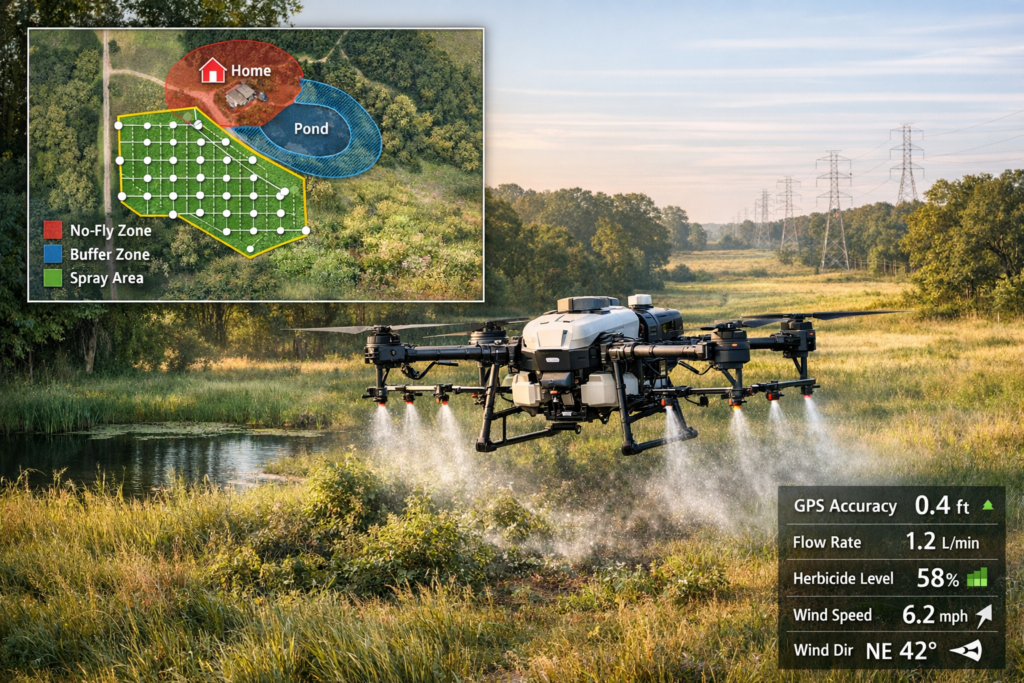
4. Plan buffer zones and setback distances around water, sensitive crops, and homes.
5. Build a detailed UAV spraying flight plan with coverage mapping to document the work.
This planning keeps aerial herbicide spraying safe, compliant, and focused on the areas that matter most for your property.
Our Drone Herbicide Application Technology
Our fleet centers around advanced DJI Agras T40 and T20P drone sprayers, designed from the ground up for agricultural aerial application. These platforms give us huge advantages over traditional equipment:
– On‑board GPS and RTK positioning for inch‑level accuracy
– Adjustable nozzles for broadcast spraying vs spot spraying, depending on your needs
– Real‑time flow monitoring to maintain precise herbicide rates
– Terrain‑following radar to keep a consistent height above uneven ground
– Automatic coverage mapping and project documentation for your records
Because drone spraying vs traditional ground rigs doesn’t require heavy tractors or booms, we minimize ruts, compaction, and soil damage. That reduced soil disturbance is a big win for pasture health and long‑term productivity. It also allows us to spray when fields are too wet for ground rigs, so you don’t lose a whole season waiting to dry out.
For East Texas aerial herbicide spraying, this combination of precision flight control, mapping, and data logging means you always know what was sprayed, where, and at what rate.
Use Cases: Taking Back Pastures, Rights‑Of‑Way, Lakes, And Overgrown Corners
Our town and surrounding countryside are full of land that has far more potential than its current condition shows. Aerial herbicide spraying lets us help you unlock that potential without tearing up the ground or risking off‑target damage. We focus on the most common needs we see among vegetation management for East Texas landowners.
Pasture, Rangeland, And Hayfield Weed Control
Pasture and hayfield spraying is one of the biggest requests we handle. When broadleaf weeds, briars, and woody brush take over, your cattle lose grazing acres and your hay yields suffer. With precision herbicide application, we can target:
– Pasture and rangeland weed control for broadleaf invaders
– Spot patches of mesquite, blackberry, or other brush
– Edge areas where trees and shrubs are creeping into open ground
Using drone herbicide application, we can:
– Fly low and targeted to protect desirable grasses
– Treat soft, boggy, or rutted ground that tractors can’t safely cross
– Apply even aerial application rates so you don’t have hot spots or misses
For landowners in Jacksonville TX, Longview, and Palestine, our pasture and rangeland spraying in Longview and Palestine, combined with local work here at home, helps reclaim forage and bring fields back into full production. Because we focus on targeted application and reduced chemical use, you aren’t paying for product that never hits a weed.
Right‑Of‑Way Vegetation Management And Access Corridors
Right‑of‑way vegetation management is another area where aerial spraying services shine. Driveways, access roads, power‑line strips, and pipeline corridors all need periodic brush and weed control to stay usable and safe. Heavy equipment isn’t always practical or welcome, especially in wet areas or near homes.
We use aerial herbicide spraying to:
– Clear low brush along fence lines and right‑of‑ways
– Maintain safe access for utility and pipeline crews
– Keep sightlines open on ranch roads and driveways
– Reduce fire risk by knocking back heavy fuel loads of tall weeds
Here, broadcast spraying vs spot spraying becomes an important decision. On wide, uniform corridors, we may use efficient broadcast passes. In mixed or sensitive areas, we switch to spot spraying, using our UAV spraying platforms to treat only the brush and weeds that need to go. That balance keeps right‑of‑way vegetation management cost‑effective while avoiding unnecessary chemical use.
Aquatic Weed Control And Lake Or Pond Spraying
Aquatic weed control demands extra care, both legally and environmentally. Lake and pond spraying with drones lets us approach these sensitive areas with much greater precision than boat rigs or bank sprayers. Around Jacksonville TX, we see a lot of:
– Pond lilies, duckweed, and filamentous algae
– Cattails and emergent weeds choking shorelines
– Invasive aquatic species spreading between waterbodies
For aquatic weed control and lake and pond spraying, we:
– Use products labeled for aquatic herbicide use only
– Carefully design buffer zones and setback distances from overflow pipes, wells, and inflow streams
– Fly low and slow to minimize herbicide drift and keep product exactly where it’s intended
This is where herbicide drift control is critical. By using low‑drift nozzles, correct droplet size, and flying within optimal wind conditions, we maintain tight control over spray drift and protect neighboring properties and water resources.
Safety, Compliance, And Drift Control: Doing It The Right Way
Anytime we talk with landowners about aerial herbicide spraying, safety and regulation come up quickly—and they should. We’re working with powerful tools, and our responsibility is to protect your property, your neighbors, and the environment while delivering the brush and weed control you need.
Licensing, Training, And Label‑Compliant Herbicide Use
Our team operates as FAA Part 107 certified drone pilots, which is the federal requirement to conduct commercial UAV crop spraying. That certification ensures we understand airspace, flight safety, and operational limits. On the chemical side, we hold the required pesticide applicator license as certified pesticide applicators under Texas state law.
Here’s what that means for you:
– Every job follows pesticide label compliance—meaning we strictly follow the product label, which is the law.
– We calculate and verify herbicide rates carefully for the specific weeds and brush being targeted.
– We select products based on integrated pest management (IPM) principles, prioritizing effectiveness while limiting unnecessary environmental load.
Integrated pest management (IPM) isn’t just a buzzword for us. We consider:
– The life cycle and timing of target weeds and invasive species
– Cultural practices (grazing, mowing, reseeding) that can support long‑term control
– The minimum effective herbicide rates to achieve lasting results
By combining IPM with precise aerial application, we can often achieve better results with less product, which translates directly into cost‑effective weed control for our clients.
Herbicide Drift Control, Buffers, And Environmental Protection
Herbicide drift—or spray drift—is one of the biggest concerns people have about aerial spraying services, and for good reason. We share that concern, which is why we build herbicide drift control into every piece of our planning and execution.
Our drift control practices include:
– Monitoring wind speed and direction before and during flights
– Choosing nozzle types and pressures that produce heavier, low‑drift droplets
– Flying at low altitudes to reduce time for droplets to drift
– Avoiding thermal inversion conditions that can carry mist long distances
We also design buffer zones and setback distances around:
– Houses, barns, and sensitive landscaping
– Neighboring crops, especially sensitive broadleaf crops
– Wells, streams, ponds, and other water resources
– Fencelines where property boundaries meet different land uses
These buffers are built into our digital maps, so the DJI Agras T40 or T20P drone sprayer simply will not spray inside those safety zones. That digital geofencing is a major advantage of drone spraying vs traditional ground rigs or older aircraft methods.
On top of that, our coverage mapping and project documentation create a clear record of:
– Exactly where product was applied
– What products and herbicide rates were used
– Weather conditions at the time of application
That level of documentation gives peace of mind to you as the landowner and provides a defensible record in the unlikely event of any questions or complaints.
Why Drones Beat Traditional Ground Rigs For Overgrown Acres
A big question we hear is: Why use drone herbicide application when a sprayer truck or tractor could do the job? For some simple, flat fields, ground rigs still make sense. But for many East Texas properties, UAV spraying is a smarter, safer, and more efficient approach.
Precision, Access, And Reduced Soil Disturbance
Our region is full of rolling ground, creek bottoms, soft spots, and timber fringes. Traditional rigs struggle in these areas. With aerial herbicide spraying, we can:
– Reach wet or boggy ground without getting stuck or leaving ruts
– Treat steep hillsides, gullies, and timber edges safely
– Avoid running over young trees, fences, or obstacles you want to protect
Drone spraying vs traditional ground rigs also gives us:
– Reduced soil disturbance: No heavy tires carving ruts, compacting topsoil, or damaging root systems.
– Less mechanical damage to forage: We’re not knocking down grass or hay just before harvest.
– Tighter control on where chemicals land, especially in irregularly shaped fields or near sensitive areas.
All of this increases the ROI on your vegetation management. You’re paying for herbicide to hit weeds, not for iron to drive around the farm.
Targeted Application And Cost‑Effective Weed Control
Because our UAV spraying systems are so precise, we can focus on targeted application and reduced chemical use. Instead of blanket‑spraying an entire property, we may:
– Broadcast treat the worst sections of a pasture
– Spot spray brush patches, invasives, or problem corners
– Leave healthy, weed‑free areas untouched
That flexibility is at the heart of cost‑effective weed control for farmers, ranchers, and acreage owners. You’re investing in the areas that truly need help.
Other advantages include:
– Fast turnaround for pasture and hayfield spraying when weather windows are tight
– Easy resprays or follow‑up drone herbicide application on stubborn patches
– Rapid deployment for right‑of‑way vegetation management after storms or utility work
For East Texas aerial herbicide spraying, this combination of speed, precision, and reduced soil disturbance is why more landowners are turning to drones every season.
Planning Your Aerial Herbicide Spraying Project In Jacksonville TX
Every property is unique, but the process we use to help you take back overgrown acres is consistent, transparent, and focused on your goals. Our passion is helping landowners turn tangled, underperforming ground into clean, usable, and productive acres again.
Step‑By‑Step: From First Call To Final Coverage Map
When you reach out to us, here’s how we typically handle an East Texas aerial herbicide spraying project:
1. Discovery call
– We discuss your property, acreage size, current issues, and goals.
– We talk through options like broadcast spraying vs spot spraying and expected timelines.
2. Site visit and mapping
– When practical, we meet you on‑site around Jacksonville TX or nearby.
– We walk key areas, identify target weeds, brush, or invasive species.
– We capture GPS boundaries and note sensitive areas for buffer zones and setback distances.
3. Prescription and proposal
– We design a precision herbicide application plan based on IPM principles.
– We confirm label‑compliant herbicide use and estimate total cost.
– We explain how drone spraying vs traditional ground rigs will work on your specific property.
4. Aerial application
– Our FAA Part 107 certified drone pilots deploy the DJI Agras T40 / T20P drone sprayer.
– We apply herbicide rates tailored to pasture, rangeland, or right‑of‑way vegetation management needs.
– We adjust for on‑site wind, temperature, and humidity to maintain herbicide drift control.
5. Documentation and follow‑up
– You receive coverage mapping and project documentation showing treated areas.
– We review what to expect in terms of weed decline, brush die‑back, and regrowth timelines.
– If needed, we schedule follow‑up aerial spraying services for stubborn patches or second‑flush weeds.
This process gives vegetation management for East Texas landowners a clear roadmap from “overgrown and frustrating” to “usable and productive.”
What Types Of Landowners Benefit Most?
We’ve seen aerial herbicide spraying create major improvements for:
– Cattle ranchers needing pasture and rangeland weed control without tearing up ground
– Hay producers around Jacksonville TX, Longview, and Palestine needing clean fields for higher‑quality hay
– Timber and recreational landowners wanting to open understory and access trails
– Acreage owners who just want their property to look cared for and manageable
– Utilities, co‑ops, and businesses needing right‑of‑way vegetation management across rough ground
– Pond and lake owners battling aquatic weeds that threaten water use and aesthetics
In each case, drone herbicide application lets us match the treatment to the problem instead of forcing your land into a “one size fits all” ground rig approach.
For more background on modern drone spraying technology and regulations, resources like the FAA’s UAS page (https://www.faa.gov/uas) offer good general information on how UAV operations are governed in the U.S.
Taking back overgrown acres doesn’t have to mean years of machetes, chainsaws, and patchy spot sprays. With the right aerial application strategy, you can make big, visible progress in a single season.
We’ve watched land that looked “lost” come back into productive pasture and clean shorelines after a well‑planned aerial herbicide spraying program. If you’re ready to see what’s actually possible on your property in and around Jacksonville TX, we’d be glad to talk through options, timing, and pricing.
You can reach us and request a quote or consultation anytime at https://dossdronetx.com/.