Why Aerial Herbicide Spraying with Drones Is Changing Everything for East Texas Landowners
If you manage pastureland, timber acreage, or row crops anywhere near Jacksonville TX, you already know the frustration of watching unwanted vegetation creep back season after season. Traditional methods of weed and brush control demand enormous amounts of time, labor, and fuel, and they still leave patches untouched. That is exactly why aerial herbicide spraying with drones has become one of the most talked-about advances in modern land management. At Doss Drone Services, we have watched firsthand as this technology moves from novelty to necessity across East Texas. Our mission is simple: deliver precise, safe, and cost-effective aerial herbicide spraying that helps landowners reclaim every acre. In the sections that follow, we walk you through how this service works, why it outperforms older approaches, and what makes our Jacksonville TX operation uniquely equipped to serve you.
The Rise of Drone Herbicide Application in Modern Agriculture
From Crop Dusters to Agricultural Spray Drones
For decades, aerial application of herbicides meant hiring a manned fixed-wing aircraft or helicopter. These platforms served their purpose, but they came with significant limitations: high mobilization costs, large minimum-acreage requirements, and substantial chemical drift that could damage neighboring crops or sensitive waterways. The ground vs. aerial spraying comparison was often a debate with no clear winner, because ground rigs offered precision but couldn’t access rough terrain, and traditional aircraft covered ground quickly but lacked finesse.
Agricultural spray drones changed that equation entirely. When we began offering drone herbicide application services out of Jacksonville TX, we immediately saw the advantages. A drone flies at lower altitudes, typically eight to fifteen feet above the canopy, which dramatically reduces off-target drift. It can navigate irregular field shapes, fence lines, creek bottoms, and hilly terrain that would stall a ground rig or force a manned aircraft to climb to an unsafe altitude. The result is a form of precision vegetation control that simply was not available to the average landowner five years ago.
Technology Behind the Precision
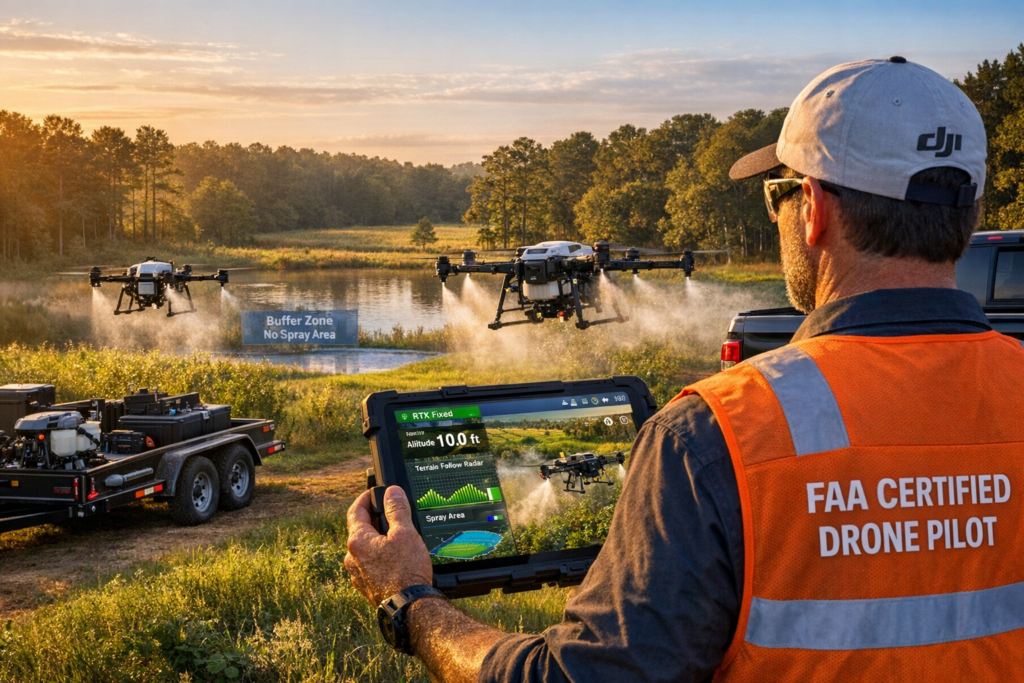
Our fleet currently includes the DJI T20P spray drone and the DJI T40 spray drone, two of the most capable platforms on the market for aerial herbicide spraying. The DJI T40 spray drone can carry up to ten gallons of mixed solution per sortie and covers roughly twenty acres per hour, depending on the application rate per acre and terrain complexity. The DJI T20P spray drone is lighter and excels in tighter areas such as orchards, small pastures, and pond margins.
Both platforms leverage precision spraying technology through onboard RTK GPS positioning, terrain-following radar, and variable-rate application software. Variable-rate application allows us to adjust the flow of herbicide in real time, increasing output over dense weed mats and reducing it in areas with adequate ground cover. This level of control is a game changer for herbicide resistance management because it ensures the correct dose reaches the target without over- or under-application, two of the primary drivers behind resistant weed populations.
We also perform rigorous calibration of spray equipment before every mission. Calibration of spray equipment ensures that each nozzle delivers the exact volume specified on the product label, which ties directly into herbicide label compliance. Skipping this step is one of the most common mistakes we see in the industry, and it can lead to legal liability, wasted product, and poor results.
How We Deliver Aerial Spraying Services Across East Texas
Serving Jacksonville TX and Surrounding Communities
Our home base is Jacksonville TX, which places us at the geographic heart of a region that desperately needs affordable commercial vegetation management services. From the piney woods east of Longview to the rolling pastures west of Palestine, landowners face a year-round battle with invasive species such as Macartney rose, Chinese tallow, yaupon holly, and dozens of aggressive broadleaf and grassy weeds. East Texas aerial herbicide spraying is not a seasonal luxury here; it is a management essential.
We routinely provide aerial herbicide spraying in Longview and Palestine, as well as throughout Cherokee, Smith, Anderson, and Rusk counties. Because our agricultural spray drones are transported on a standard truck and trailer, we can set up on almost any property in under thirty minutes. There are no runway requirements, no fuel trucks, and no massive staging areas. That logistical simplicity is one reason drone spraying services for landowners have grown so rapidly in this part of the state.
Step-by-Step: What a Typical Mission Looks Like
We believe transparency builds trust, so here is exactly how a project unfolds when you hire us for aerial herbicide application:
1. Consultation and site assessment. We visit or review satellite imagery of your property to identify target species, map no-spray buffer zones near water features or neighboring crops, and determine the best timing based on environmental conditions for spraying, including wind speed, temperature, and humidity.
2. Product selection. Depending on your goals, we recommend either selective herbicides vs. non-selective herbicides. Selective herbicides target specific weed families while leaving desirable grasses or crops unharmed, making them ideal for pasture weed control. Non-selective herbicides are better suited for fence-row cleanups, right-of-way clearance, or total vegetation removal on industrial sites.
3. Pre-flight calibration. We calibrate every nozzle, verify GPS accuracy, and load the precise herbicide rates and coverage data into the flight controller. This calibration of spray equipment step is non-negotiable.
4. Flight execution. Our FAA Part 107 certified pilots launch the drone and monitor every pass in real time. The drone follows a pre-programmed flight path but can be overridden manually if we spot an obstacle or a sensitive area the mapping may have missed.
5. Post-flight reporting. After the mission, we provide a detailed map showing exactly where product was applied, the application rate per acre used in each zone, and any areas intentionally excluded as no-spray buffer zones.
This structured workflow is central to integrated vegetation management (IVM), a philosophy that combines chemical, mechanical, and cultural control methods into a long-term strategy rather than relying on a single tactic. We often recommend IVM plans that pair our aerial herbicide spraying with follow-up mowing or prescribed burns for the best multi-season results.
Use Cases: From Pastures to Ponds and Everything Between
Pasture Weed Control and Brush Management
Pasture weed control is far and away our most requested service in Jacksonville TX. Overgrazed or neglected pastures quickly become dominated by thistles, horsenettle, broomweed, and smutgrass, all of which reduce forage quality and carrying capacity. A single well-timed drone herbicide application of a selective broadleaf herbicide can restore productivity within a single growing season.
Brush and woody plant control is the next most common request. Species like mesquite, huisache, and eastern red cedar can reduce usable pasture by fifty percent or more if left unchecked. Our precision spraying technology allows us to target individual brush clusters with a foliar-applied herbicide while preserving surrounding grass cover. This selective approach is far more efficient than the broad-swath coverage typical of manned aircraft.
For larger-scale brush and woody plant control, we sometimes apply pre-emergent and post-emergent herbicides in a two-pass strategy. A post-emergent product knocks back existing growth, while a pre-emergent herbicide applied to the soil prevents new seedlings from establishing. This combination extends the effective control window from a few months to an entire year or longer, which is a cornerstone of herbicide resistance management because it attacks the weed population at two different life stages.
Invasive Species Management and Aquatic Vegetation
East Texas aerial herbicide spraying is not limited to dry land. Invasive species management around farm ponds, stock tanks, and creek margins is a growing segment of our business. Giant salvinia, water hyacinth, and alligator weed can choke a pond in a single season, harming fish populations and rendering water sources unusable for livestock.
Pond and aquatic vegetation control from a drone is uniquely effective because the aircraft hovers just above the water surface, directing the spray downward with minimal drift. We use aquatic-labeled herbicides and observe strict no-spray buffer zones around drinking-water intakes and downstream outflows. Environmental conditions for spraying over water are even more critical than on dry land; we never spray when wind speeds exceed eight miles per hour or when rain is forecast within six hours.
Agricultural weed control in row-crop settings is another area where precision vegetation control shines. Cotton, corn, and soybean fields around Jacksonville TX benefit from targeted aerial herbicide application that can treat problem areas without driving heavy equipment through wet soil, which causes compaction and rut damage. Our variable-rate application capabilities mean we can prescribe a higher application rate per acre in heavy weed pockets while dialing back in cleaner sections, saving chemical costs and reducing environmental impact.
Safety, Compliance, and Why Choosing the Right Provider Matters
Regulatory Framework and Pilot Certification
Operating agricultural spray drones commercially requires more than just knowing how to fly. Our pilots are FAA Part 107 certified pilots who have completed additional training specific to aerial application of herbicides, including safe handling of restricted-use products and emergency response procedures. In Texas, drone applicators must also hold or operate under a Texas Department of Agriculture pesticide applicator license, ensuring herbicide label compliance at every step.
Herbicide label compliance is not optional. The label is a federal legal document, and violating its instructions carries civil