Aerial Herbicide Spraying Is Changing the Game for East Texas Landowners
Across the rolling pastures and dense woodlands surrounding Tyler TX, a quiet revolution is unfolding. Landowners, ranchers, and hay producers are discovering that aerial herbicide spraying offers a faster, safer, and more precise way to reclaim land from aggressive weeds, thorny brush, and invasive species. For decades, vegetation management meant loading up a truck-mounted sprayer, walking fence lines with a backpack unit, or hiring a helicopter crew at eye-watering hourly rates. We have spent years watching those methods fall short—missed patches, wasted chemical, torn-up pastures, and budgets blown before the season even peaks. That is exactly why we built Doss Drone Services around a better approach. Our passion is helping East Texas landowners protect their investments through drone herbicide spraying technology that delivers label-compliant applications with pinpoint accuracy and dramatically lower cost. If you manage hay fields, cattle pasture, ponds, utility corridors, or timber tracts in or around Tyler TX, this article will walk you through everything you need to know about how aerial spraying services are quietly transforming farm weed control.
Why Aerial Herbicide Spraying Outperforms Traditional Methods
The Limits of Ground-Based Spraying and Manual Labor
Ground-based spraying has served agriculture well for generations, but it comes with real limitations that East Texas terrain magnifies. Muddy creek bottoms, steep hillsides, dense cedar breaks, and fire-ant-infested fence lines make tractor access dangerous and sometimes impossible. When a skid sprayer cannot reach the problem, weeds win. Manual backpack spraying is precise in small gardens, but asking a crew to cover two hundred acres of mesquite-choked rangeland is neither practical nor cost-effective. Labor costs climb, spray coverage becomes inconsistent, and worker fatigue introduces safety risks that conflict with worker protection standards established to shield applicators from chemical exposure. We have seen ranchers spend entire weekends battling a ten-acre patch of giant ragweed only to watch it bounce back because coverage gaps allowed survivors to reseed.
Helicopter Spraying and Fixed-Wing Aerial Spraying—Expensive and Less Precise
Before drones entered the picture, helicopter spraying and fixed-wing aerial spraying were the only options for treating large or inaccessible acreage from the air. Both methods can cover enormous tracts quickly, but they carry steep mobilization fees, high fuel costs, and minimum-acreage requirements that shut out smaller operators. More importantly, flying at higher altitudes and faster speeds increases the risk of herbicide drift, sending fine droplets beyond the target zone and onto neighboring crops, waterways, or sensitive habitats. Spray drift mitigation has always been a headache for manned aircraft operators because environmental conditions change rapidly and the pilot’s view from one hundred feet up offers limited detail. Aerial herbicide application via drone solves many of these problems. Our UAV spraying platforms fly at ten to fifteen feet above the canopy, well below the altitude where wind shear scatters droplets. The result is tighter swath accuracy, less chemical waste, and vastly improved herbicide drift control—all at a fraction of the cost of a manned aircraft.
Drone Herbicide Spraying Bridges the Gap
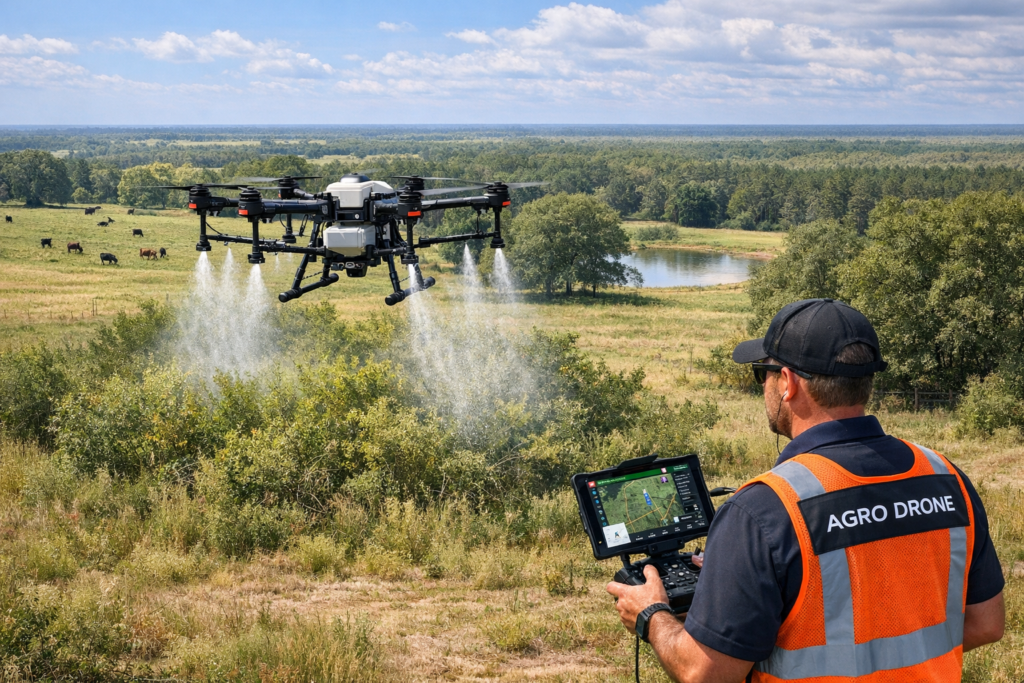
Drone spraying sits at the sweet spot between ground rigs and manned aircraft. It combines the accessibility of aerial application with the precision of a handheld nozzle. Our calibrated spray systems use flow rate control technology that adjusts output in real time based on ground speed, ensuring consistent application rates and coverage across every pass. Because we program flight paths using GIS mapping and prescription maps, each mission targets only the vegetation that needs treatment. Non-target species and labeled crops adjacent to the spray zone remain untouched. That level of precision herbicide application simply is not achievable with a fixed-wing plane roaring overhead at one hundred twenty knots.
For agricultural spraying in East Texas, where fields can border timber, stock ponds, or residential properties, this precision is not just a luxury—it is a necessity. We have built our entire workflow around respecting buffer zones and no-spray zones, programming them into the flight plan before a single rotor spins. The outcome is cost-effective vegetation control that satisfies landowners, regulators, and neighbors alike.
How We Deliver Safe, Compliant Aerial Spraying Services in Tyler TX
FAA Part 107 Certified Drone Pilots and Regulatory Compliance
Aerial spraying safety regulations are rigorous for good reason. We operate under FAA Part 107 certified drone pilots who have completed additional agricultural-specific training, including pesticide handling and emergency procedures. Every member of our flight crew understands the Federal Aviation Administration’s operational limitations, airspace authorizations, and the supplemental requirements for spraying operations. Compliance is non-negotiable at Doss Drone Services. We carry the appropriate insurance, maintain current pilot certifications, and file all required notices before each mission.
Beyond FAA rules, the chemicals we apply are governed by the Environmental Protection Agency. We use only EPA-registered herbicides and follow every label instruction—from mixing ratios and re-entry intervals to personal protective equipment. Our commitment to label-compliant applications protects our team, your land, and the surrounding environment.
Herbicide Selection—Selective, Residual, and Tank-Mix Strategies
Effective pasture weed control depends on choosing the right chemistry for the target species and the desired forage. We work extensively with selective herbicides that eliminate broadleaf invaders while leaving desirable grasses unharmed. For heavy infestations, we may recommend residual herbicides that continue working in the soil for weeks, preventing the next flush of germination. In many cases, we design a custom tank mix and adjuvants package that combines a post-emergent herbicide for visible weeds with a pre-emergent herbicide to block future growth. Understanding the distinction between post-emergent vs pre-emergent herbicides is critical to building a season-long weed management plan rather than simply putting out fires one flush at a time.
Every recommendation we make fits within an integrated pest management framework. Integrated pest management, commonly called IPM, encourages combining chemical, cultural, and mechanical tactics to reduce overall herbicide use while maximizing results. For example, after an aerial herbicide application knocks back an invasive species infestation, we might advise overseeding with a competitive forage variety that crowds out returning weeds. That IPM approach lowers long-term costs and supports environmental stewardship by reducing the total volume of chemical applied over time.
Record-Keeping and Application Reports
Transparency matters, especially when chemicals are involved. After every mission, Doss Drone Services delivers detailed record-keeping and application reports that document the date, time, weather conditions, product applied, application rates, GPS flight logs, and total acreage treated. These application reports satisfy state regulatory requirements and give landowners a permanent record for their files. If an audit or neighbor inquiry ever arises, you have the documentation to prove every drop was placed exactly where it was supposed to be. We consider thorough record-keeping and application reports an essential part of our service, not an afterthought.
Real-World Use Cases—From Pastures to Ponds in East Texas
Pasture and Hayfield Spraying for Ranchers and Hay Producers
Pasture and hayfield spraying is the backbone of our workload around Tyler TX and across the broader East Texas region. Landowners, ranchers, and hay producers depend on clean, productive fields to sustain livestock and generate hay revenue. Common targets include:
– Spiny amaranth and pigweed overtaking Bermuda grass hayfields
– Broadleaf plantain and dandelion reducing forage quality in improved pastures
– Horsenettle and Carolina snailseed poisoning cattle
– Annual broomweed exploding in overgrazed rangeland
Our drone herbicide spraying platforms treat these weeds quickly—often covering fifty to eighty acres in a single day—with minimal disruption to grazing rotations. Because the drone does not compact soil or create ruts, landowners, ranchers, and hay producers can move cattle back onto treated pasture as soon as the re-entry interval expires, which is typically twenty-four to forty-eight hours depending on the product label.
Brush Control and Invasive Species Control
East Texas aerial herbicide spraying is uniquely suited to brush control because our region’s most problematic woody species—mesquite, Macartney rose, Chinese tallow, and yaupon holly—thrive in places ground equipment cannot reach. Brush management on steep creek banks, densely wooded fence rows, and rocky hillsides becomes straightforward when a drone can hover directly above the canopy and deliver a targeted dose of triclopyr or a picloram blend.
Invasive species control is a growing concern statewide. Chinese privet and Japanese climbing fern are spreading aggressively through East Texas bottomlands, and early intervention is far cheaper than restoration after a full-blown invasion. Precision herbicide application from a UAV allows us to treat individual clusters within a native plant community without broadcasting chemicals across the entire area, protecting labeled crops and non-target species in the process.
Aquatic Weed Control and Right-of-Way Vegetation Management
Stock ponds and small lakes choked with duckweed, water hyacinth, or filamentous algae reduce water quality and can suffocate fish populations. Aquatic weed control requires specialized EPA-registered herbicides approved for use near water, along with careful attention to buffer zones and no-spray zones around inflows and outflows. Our drone spraying platforms excel here because they can fly low and slow over the water surface, depositing product exactly where it is needed without overspray reaching adjacent pastures.
Right-of-way vegetation management is another growing segment. Utility companies, pipeline operators, and county road departments in East Texas need to keep corridors clear of encroaching brush. Aerial herbicide application via drone handles these narrow, linear targets more efficiently than a bush hog and with greater environmental impact awareness than broadcast spraying from a helicopter. We have completed multiple right-of-way vegetation management projects where drone technology cut treatment time in half compared to previous years’ ground-based approach.
Getting Started with Doss Drone Services for Cost-Effective Vegetation Control
Our Process from First Call to Final Report
Working with Doss Drone Services is straightforward. Here is how a typical project unfolds:
1. Consultation – We discuss your property, target weeds, and goals. We review any existing GIS mapping or prescription maps you may have, or we create them using our own survey flights.
2. Site Assessment – Our FAA Part 107 certified drone pilots scout the property, noting obstacles, sensitive areas, and optimal flight paths. We identify buffer zones and no-spray zones and program them into the mission software.
3. Herbicide Planning – We recommend the appropriate selective herbicides, residual herbicides, or tank mix and adjuvants combinations based on weed species, growth stage, soil type, and weather forecast. Every product is an EPA-registered herbicide applied at label rates.
4. Aerial Application – Using calibrated spray systems with flow rate control, we execute the mission. Real-time telemetry ensures consistent application rates and coverage across the entire treatment area.
5. Post-Mission Reporting – You receive comprehensive record-keeping and application reports, including GPS flight logs, product details, weather data, and before-and-after imagery when requested.
This streamlined process delivers cost-effective vegetation control without the hassle, delays, or hidden fees that plague traditional aerial spraying services.
Why Landowners Across East Texas Choose Us
Doss Drone Services has earned the trust of landowners, ranchers, and hay producers throughout the region because we combine local knowledge with cutting-edge technology. We understand East Texas soils, climate patterns, and weed pressure cycles because we live and work here. Our environmental stewardship commitment means we treat your land the way we treat our own—carefully, responsibly, and with long-term productivity in mind. Agricultural spraying in East Texas demands operators who respect both the land and the regulations that protect it, and we take aerial spraying safety regulations seriously on every single job.
Whether you need pasture weed control on a family ranch, invasive species control along a creek bottom, aquatic weed control on a trophy bass pond, or brush control across hundreds of acres of inherited timberland, our aerial herbicide spraying solutions scale to fit your needs and your budget.
Take the Next Step Toward Cleaner, More Productive Land
Weeds do not wait, and neither should you. Every week of unchecked growth means deeper root systems, heavier seed banks, and higher treatment costs down the road. Aerial herbicide spraying through drone technology gives you the speed, precision, and affordability to stay ahead of the problem instead of constantly chasing it.
We would love to learn about your property, walk you through our process, and put together a custom plan that fits your acreage and goals. Doss Drone Services is here to make East Texas aerial herbicide spraying simple, transparent, and effective for every landowner we serve.
Ready to reclaim your land? Visit us at https://dossdronetx.com/ to schedule your free consultation. Let us show you what precision aerial herbicide application can do for your operation in Tyler TX and across East Texas. We are just one call or click away from helping you take back control of your pastures, ponds, and property.