The Enduring Role of Fixed-Wing Crop Dusters in Modern Agriculture
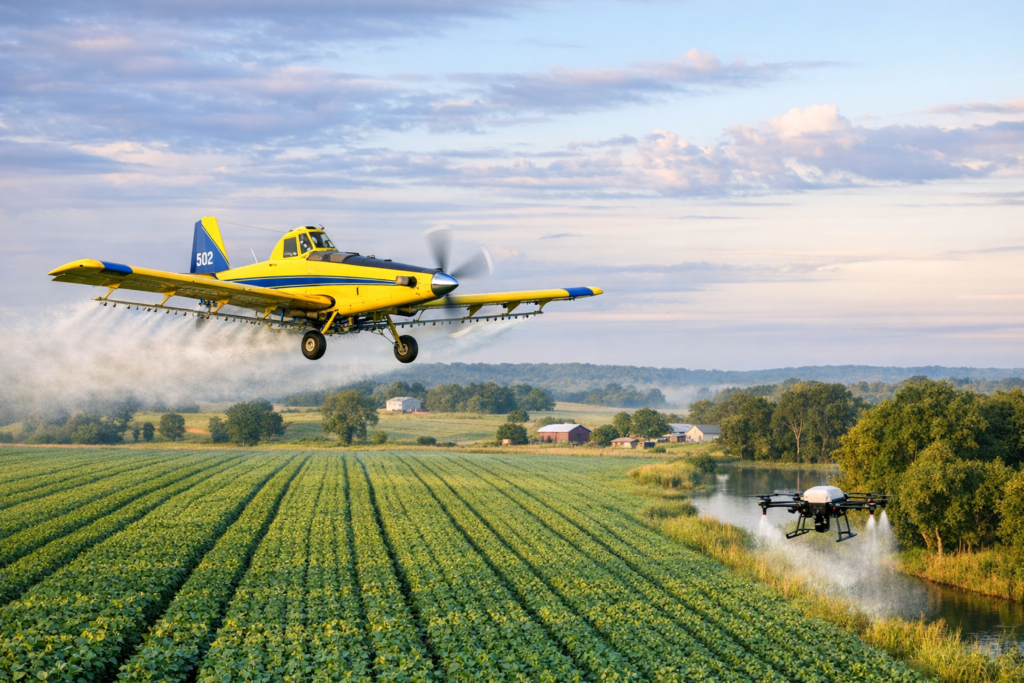
When most people picture a crop duster, they imagine a small airplane roaring across a vast cotton field at dawn, trailing a fine mist behind it. That image is not a relic of the past. Fixed-wing crop dusters remain one of the most efficient tools in agricultural aviation, and we see their impact firsthand here in Jacksonville TX every growing season. At Doss Drone Services, we are passionate about drone spraying and precision agriculture, but we also have deep respect for the role that traditional spray planes continue to play. In fact, understanding where fixed-wing agricultural aircraft excel and where agricultural drones shine is exactly what helps us serve East Texas growers better. This article explores why crop duster airplanes still dominate certain jobs, how they compare to drone crop spraying, and how smart operators blend both technologies for the best results.
What Makes Fixed-Wing Crop Dusters So Effective for Large-Scale Aerial Application
Speed, Swath Width, and Sheer Acreage Coverage
The single greatest advantage of a fixed-wing crop duster is its ability to cover enormous acreage in a short window of time. A modern ag plane like the Air Tractor AT-502 or a Thrush 510G can carry anywhere from 400 to 800 gallons of product, fly at speeds between 130 and 160 miles per hour, and lay down a swath width of 60 to 80 feet on every pass. That translates to a coverage rate that simply dwarfs what any other platform can achieve on a per-hour basis. When a rice farmer in East Texas needs 1,200 acres treated with a fungicide spraying application before afternoon thunderstorms roll in, there is no substitute for that kind of speed.
Turn time and ferry time matter just as much as cruise speed. Aerial applicators flying fixed-wing agricultural aircraft from a nearby airstrip can reload, take off, and return to the field in minutes. The combination of large hopper capacity, rapid turnaround, and wide swath width means a single spray plane can realistically treat 800 to 1,500 acres in a single day depending on conditions, product mix, and field layout.
Operating Costs at Scale
Fuel efficiency and operating costs are always top of mind for agricultural pilots and the growers who hire them. While it is true that crop dusting aircraft burn significant fuel, the cost per acre actually drops as field size increases. On a 2,000-acre operation, the economics of a fixed-wing crop duster are tough to beat. The application rate stays consistent, the infrastructure is well established, and the custom aerial application services industry has had decades to optimize logistics. Agricultural co-ops across East Texas regularly contract with aerial applicators for pesticide application and herbicide application precisely because the per-acre price point remains competitive on large-scale work.
Here in Jacksonville TX, we watch ag planes take off from local strips all spring and summer. The pilots know every fence line, every tree row, and every power line in the county. That institutional knowledge, combined with the raw capability of the aircraft, is why fixed-wing crop dusters still handle the lion’s share of aerial application work nationwide.
Safety, Regulation, and Precision: How Spray Planes Stay Compliant and Accurate
FAA Part 137 and the Regulatory Framework
Every crop dusting aircraft operating in the United States must comply with FAA regulations for crop dusters outlined under FAA Part 137, which governs agricultural aircraft operations specifically. This regulatory framework covers pilot certification, aircraft maintenance, operational limitations, and safety protocols. Agricultural pilots must hold a commercial pilot certificate at minimum, and many hold additional ratings and undergo specialized training in low-level maneuvering, chemical handling, and emergency procedures.
FAA regulations for crop dusters also address buffer zones, which are mandatory setback distances from sensitive areas such as waterways, residences, schools, and organic fields. These buffer zones vary depending on the product being applied, wind conditions, and the specific label requirements of the pesticide or herbicide in question. Compliance is not optional, and reputable aerial applicators take these rules seriously because the consequences of violations range from fines to license revocation.
Nozzle Selection, Droplet Size, and Drift Control
Modern spray planes are far more sophisticated than many people realize. Nozzle selection is one of the most critical decisions an ag pilot makes before every flight. The type and orientation of the spray nozzles on the spray boom directly determine the droplet size distribution, which in turn determines how effectively the product reaches the target canopy and how much spray drift occurs.
Larger droplets reduce drift but may decrease coverage on the leaf surface. Smaller droplets improve coverage but are more susceptible to being carried off-target by wind. The best agricultural pilots adjust their nozzle selection, boom length, and flying height based on current conditions, the specific product being applied, and the desired spray pattern. GPS guidance systems now standard on most crop duster airplanes allow pilots to fly perfectly spaced parallel passes, eliminating skips and overlaps that waste product and money.
Drift control is a constant concern in East Texas crop spraying because our region features a patchwork of different crops, residential areas, and ecologically sensitive zones. A skilled ag pilot using proper nozzle selection, appropriate droplet size, and real-time wind monitoring can achieve spray drift levels well within acceptable limits, but it requires training, experience, and the right equipment.
Integrated Pest Management and Responsible Application
Fixed-wing crop dusters are a key tool within integrated pest management, or IPM, programs. Rather than blanket-spraying entire farms on a calendar schedule, modern agricultural aviation integrates scouting data, threshold-based decision-making, and targeted aerial application. When a pest outbreak hits a specific area of a field, aerial applicators can be dispatched quickly to apply the right product at the right application rate before the problem spreads. Fungicide spraying to prevent crop diseases, herbicide application to manage resistant weeds, pesticide application against insect infestations, and even fertilizer spreading at critical growth stages all fall within the scope of work that crop dusting aircraft handle routinely.
Fixed-Wing vs Drone Crop Dusters: Where Each Technology Wins
The Rise of Agricultural Drones
We would be remiss not to talk about the technology that sits at the heart of our business. Agricultural drones have advanced dramatically in the past five years. Drone spraying platforms can now carry 4 to 10 gallons of product, fly autonomously along pre-programmed routes, and deliver variable rate application with incredible field-level precision. At Doss Drone Services, we use this technology every day for East Texas crop spraying operations where precision agriculture makes a measurable difference.
The strength of agricultural drones lies in their ability to treat small, irregular, or hard-to-access areas that would be impractical or unsafe for a full-size spray plane. Think about a 15-acre pasture surrounded by trees, a spot treatment in the corner of a 500-acre field identified by remote sensing and NDVI imagery, or a sensitive area near a residential neighborhood where buffer zones make fixed-wing operations difficult. In those scenarios, drone spraying is not just competitive, it is clearly superior.
Variable rate application is another area where agricultural drones excel. Using NDVI imagery and remote sensing data, we can create prescription maps that tell the drone exactly how much product to apply at every point in the field. This level of precision agriculture reduces chemical usage, lowers input costs, and minimizes environmental impact. It is not something a fixed-wing crop duster can replicate with the same granularity, even with GPS guidance systems.
Where Fixed-Wing Agricultural Aircraft Still Dominate
The fixed-wing vs drone crop dusters debate often gets framed as an either-or proposition, but the reality is more nuanced. Here is a straightforward comparison of where each platform holds an advantage:
– Acreage capacity: A single spray plane covers 800 to 1,500 acres per day. A single agricultural drone covers 30 to 100 acres per day depending on tank size and battery life. For large-scale operations, fixed-wing crop dusters win on throughput alone.
– Speed of deployment: When a sudden pest outbreak threatens thousands of acres, crop dusting aircraft can mobilize and complete the job in hours, not days. Time-sensitive pesticide application and fungicide spraying often demand that speed.
– Payload: Ag planes carry hundreds of gallons per load. Drones carry single-digit gallons. For fertilizer spreading and heavy-volume herbicide application, the math overwhelmingly favors fixed-wing agricultural aircraft.
– Wind tolerance: Spray planes can operate in higher wind conditions than most agricultural drones, which typically ground themselves when winds exceed 10 to 15 miles per hour. In East Texas, where afternoon winds are common, this matters.
– Precision in small areas: Agricultural drones win. Spot treatments, variable rate application, and work near sensitive buffer zones are ideal drone spraying tasks.
– Data integration: Drones paired with remote sensing and NDVI imagery provide actionable field data that informs better decision-making across the entire operation, including decisions about when to call in a fixed-wing crop duster.
The honest answer to the fixed-wing vs drone crop dusters question is that the two technologies are complementary, not competitive. We tell our clients that regularly.
How Doss Drone Services Bridges the Gap
At Doss Drone Services, we built our business around precision agriculture and the unique capabilities that agricultural drones bring to the table. But we are also pilots, technologists, and farmers at heart, and we understand that no single tool solves every problem. When a grower near Jacksonville TX calls us looking for crop dusting services near me, we have an honest conversation about what they need. If they have 2,000 acres of soybeans that need a blanket herbicide application, we will be the first to say that a fixed-wing crop duster is the right call. If they have 40 acres of specialty crops that need variable rate application based on drone-captured NDVI data, that is exactly where our custom aerial application services deliver the most value.
Our approach combines the best of both worlds. We use remote sensing flights to map fields, identify problem areas, and generate prescription maps. For targeted treatments, we deploy our drone spraying fleet to apply product with pinpoint accuracy. For large-scale work that demands the speed and payload of crop duster airplanes, we coordinate with trusted agricultural pilots and aerial applicators in the region to ensure the job gets done right.
This hybrid model reflects where agricultural aviation is heading. The future is not fixed-wing or drone. The future is fixed-wing and drone, each deployed where it makes the most sense.
Why East Texas Growers Are Choosing a Blended Approach in Jacksonville TX
The Unique Demands of Our Region
East Texas crop spraying presents its own set of challenges. Our fields range from sprawling row-crop operations to smaller specialty plots. The terrain includes rolling hills, dense tree lines, and residential areas interspersed with agricultural land. Weather windows for aerial application can be short, with morning dew delaying start times and afternoon heat and wind narrowing the window further.
In this environment, having access to both fixed-wing crop dusters and agricultural drones is not a luxury. It is a practical necessity. Agricultural co-ops and individual growers in the Jacksonville TX area increasingly recognize that the smartest pest management and crop nutrition strategies use data-driven precision agriculture to decide what to apply, where, and how, and then match the right delivery platform to the task.
Real Results From Combining Technologies
We have seen growers reduce their overall chemical spend by 15 to 25 percent by using drone-based remote sensing to identify which portions of a field actually need treatment, then applying product only where it is needed. In some cases, that means a drone handles the targeted application directly. In other cases, the data informs a more precise prescription that an ag pilot follows using GPS guidance systems on the spray plane, narrowing the treated area from the full field to just the zones that need attention.
Fertilizer spreading is another area where the blended approach pays off. A fixed-wing agricultural aircraft handles the bulk application across hundreds of acres, while a drone follows up with variable rate application to boost rates in areas where soil tests or NDVI imagery indicate deficiencies. The result is better crop performance with less waste.
Drift control also improves when the right platform is matched to the right job. Using agricultural drones for applications near homes, waterways, or organic fields respects buffer zones more easily because the drone flies lower and slower, producing less off-target movement. Meanwhile, fixed-wing crop dusters handle the open, interior sections of large fields where their speed and efficiency shine.
Our Commitment to Jacksonville TX and Beyond
Doss Drone Services is proud to be part of the Jacksonville TX agricultural community. We are not here to replace the ag pilots and aerial applicators who have served this region for decades. We are here to add a new tool to the toolbox and to help growers make smarter decisions about how they protect and nourish their crops. Whether someone searches for crop dusting services near me looking for a drone solution, a referral to a fixed-wing operator, or a comprehensive plan that uses both, we are ready to help.
Our custom aerial application services are built on transparency, technical expertise, and a genuine desire to see East Texas agriculture thrive. We invest in the latest precision agriculture technology, maintain close relationships with fixed-wing operators, and stay current with FAA regulations for crop dusters and drone operations alike so that every recommendation we make is grounded in both science and practical experience.
Partner With Doss Drone Services for Smarter Crop Care
Fixed-wing crop dusters are not going anywhere, and they should not. Their speed, payload, and proven track record make them indispensable for large-scale aerial application across the agricultural heartland. At the same time, agricultural drones have earned their place in the modern grower’s toolkit, offering unmatched precision, data-driven insights, and the ability to handle jobs that spray planes simply cannot do as efficiently.
The key takeaway is simple: match the platform to the job. Big acreage, tight timelines, and heavy product loads call for a fixed-wing crop duster. Targeted treatments, variable rate application, and detailed field mapping call for drone spraying. And the smartest operations use both.
If you farm in or around Jacksonville TX and want to explore how a blended approach to agricultural aviation can save you money, reduce chemical inputs, and improve crop outcomes, we would love to talk. Reach out to us at Doss Drone Services to schedule a consultation. Let us show you how precision agriculture and good old-fashioned aerial expertise come together to deliver the best results for your operation.