Why Aerial Fungicide Application Is Changing the Game for East Texas Growers
There is a quiet revolution happening above the fields and pastures surrounding Jacksonville TX, and most people never even notice it. While traditional farming methods have served growers well for generations, the emergence of aerial fungicide application is redefining how we protect crops from devastating foliar diseases. At Doss Drone Services, we have witnessed firsthand how this technology is helping East Texas farms and ranches achieve healthier stands, stronger yields, and better long-term profitability. Whether you grow row crops like corn, soybeans, cotton, or wheat, or you manage specialty operations across Cherokee County, the ability to apply fungicide from the air with pinpoint accuracy is no longer a luxury reserved for massive commercial operations. It is an accessible, practical tool that is quietly transforming crop protection for growers of every scale. In this article, we will walk you through how aerial fungicide application works, why it outperforms older methods, and how our team at Doss Drone Services is bringing precision agriculture directly to your doorstep.
The Evolution from Crop Dusters to Drone Fungicide Application
A Brief History of Aerial Spraying
Aerial application has been part of American agriculture since the early twentieth century. Crop dusters, the manned aerial applicators that became iconic symbols of rural life, were among the first tools that allowed farmers to treat large acreages quickly. For decades, these fixed-wing aircraft and helicopters served as the primary method of aerial spraying for fungicides, herbicides, and insecticides across the United States.
However, traditional crop dusters come with well-documented limitations. Their high flight speeds and altitude make it difficult to achieve the kind of uniform coverage that modern crop protection demands. Drift is a persistent concern, as large swath widths and variable wind conditions can carry chemical droplets into buffer zones and sensitive areas like waterways, neighboring properties, and pollinator habitats. Additionally, the cost of hiring a manned aerial applicator can be prohibitive for small and mid-sized operations, especially when only a portion of a field needs treatment.
We respect the legacy of manned aerial applicators and the role they have played in feeding the world. But we also recognize that technology has given us a better path forward.
How Drone Fungicide Application Changes the Equation
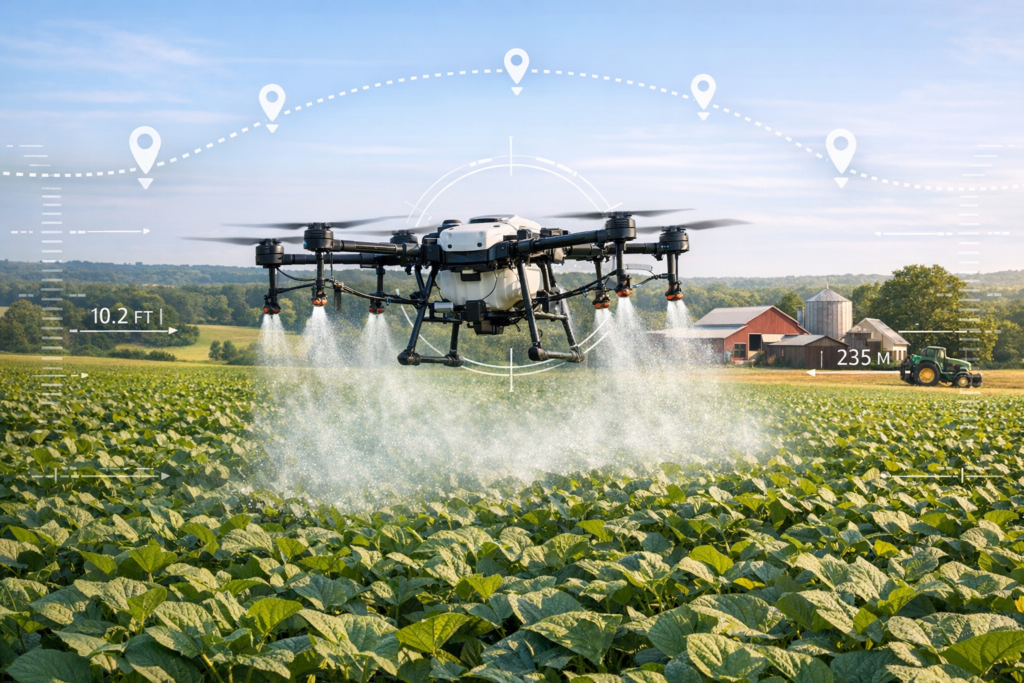
Drone fungicide application, sometimes called fungicide drone spraying, represents a fundamental leap in how we deliver crop protection products. Modern agricultural drones fly lower, slower, and with far greater control than traditional aircraft. This translates directly into superior spray coverage and dramatically reduced drift.
At Doss Drone Services, our aerial spraying operations use GPS-guided flight paths that follow the exact contours of your field. Every pass is calculated, every swath is measured, and every droplet is placed with intention. This is precision agriculture in its most tangible form. Rather than blanketing an entire area and hoping for adequate coverage, we use variable rate application technology to adjust the volume of fungicide delivered based on real-time field conditions, canopy density, and the specific disease pressure you are facing.
The comparison to ground rigs is equally important to understand. Ground-based sprayers require driving heavy equipment through standing crops, which causes compaction, damages plants, and creates wheel tracks that can harbor disease. During peak growing season, when fungicide application timing is most critical, the canopy may be too tall and dense for ground rigs to navigate without causing significant crop loss. Drone fungicide application eliminates these problems entirely. We fly above the crop, delivering product exactly where it is needed without ever touching a single plant.
For East Texas farms and ranches, where field sizes, terrain, and weather windows vary widely, this flexibility is invaluable. We can treat a forty-acre cotton field just as efficiently as a five-acre specialty plot, and we can mobilize quickly when disease pressure spikes unexpectedly after a stretch of warm, humid weather, which is something we see frequently around Jacksonville TX.
Precision Spraying, Canopy Penetration, and Drift Control
Achieving Uniform Coverage Where It Matters Most
One of the most common questions we receive is whether a drone can actually deliver the same level of spray coverage as larger aircraft or ground equipment. The answer is not just yes; in many situations, it is measurably better.
The key lies in how agricultural drones generate downwash. The rotors of our multi-rotor drones create a powerful column of air that pushes directly downward as the aircraft moves across the field. This downwash physically opens the crop canopy and drives fungicide droplets deep into the plant architecture. The result is exceptional canopy penetration, ensuring that fungicide reaches the lower and middle leaves where many foliar diseases originate.
Diseases like gray leaf spot in corn, frogeye leaf spot in soybeans, target spot in cotton, and Septoria leaf blotch in wheat often establish themselves on lower leaves before spreading upward. If your fungicide only coats the top of the canopy, you are missing the very infection sites that need treatment most. Our aerial fungicide application approach addresses this directly. We calibrate water volume and droplet size to optimize penetration without sacrificing coverage on upper leaf surfaces. This dual-layer protection is something that traditional aerial spraying from fixed-wing crop dusters simply cannot replicate at the same level of consistency.
Drift Reduction Technology and Environmental Stewardship
Drift control is not just a regulatory requirement for us; it is a core principle of how we operate. Every aerial fungicide application we perform incorporates multiple layers of drift reduction technology and procedural safeguards.
First, we select nozzle configurations that produce droplet sizes optimized for the specific fungicide being applied. Larger droplets are less susceptible to wind drift, while finer droplets provide better coverage on leaf surfaces. We balance these competing demands based on the product label, the target crop, and current weather conditions. We monitor wind speed, wind direction, temperature, and relative humidity before and during every application.
Second, our drones fly at significantly lower altitudes than manned aircraft, typically between six and fifteen feet above the canopy. This dramatically reduces the distance droplets must travel before reaching the target, which in turn reduces the opportunity for drift. We also program precise flight paths that respect buffer zones and sensitive areas, including waterways, residential properties, beehives, and organic fields.
Third, we follow strict application rates and label compliance protocols. Every product we apply is an EPA-approved fungicide, and we calibrate our equipment to deliver exactly the rate specified on the label. Over-application wastes money, increases environmental impact, and can contribute to fungicide resistance. Under-application fails to protect the crop. Precision spraying allows us to hit the target rate consistently across every acre.
This commitment to environmental stewardship is something we take seriously at Doss Drone Services. We believe that effective crop protection and responsible environmental practices are not opposing goals. They go hand in hand, and aerial fungicide application through drone technology is one of the best tools available to achieve both simultaneously.
Timing, Disease Management, and Integrated Pest Management
Why Fungicide Application Timing Is Everything
In crop protection, timing is arguably the single most important variable determining whether a fungicide application succeeds or fails. Apply too early, and the product may degrade before disease pressure peaks. Apply too late, and the pathogen has already established itself beyond the point where fungicide can be effective.
This is where the agility of Doss Drone Services aerial spraying becomes a critical advantage. Unlike scheduling a crop duster days or weeks in advance, or waiting for a ground rig to become available during the busiest stretch of the season, our drone operations can be mobilized rapidly. When you see the first signs of leaf diseases in your field, or when weather forecasts indicate conditions favorable for disease development, we can often be on-site within a day or two.
For row crops like corn, soybeans, cotton, and wheat, the optimal fungicide application timing windows are well established but narrow. Corn is typically treated between VT and R1 growth stages. Soybeans respond best to fungicide applied at R3. Cotton and wheat have their own critical windows tied to canopy closure and heading, respectively. Missing these windows by even a few days can mean the difference between a highly effective application and one that barely moves the needle on yield protection.
Our team monitors local conditions around Jacksonville TX and the broader East Texas region closely. We stay in communication with our grower partners so that when the window opens, we are ready to fly.
Positioning Aerial Fungicide Within an IPM Program
We are strong advocates of integrated pest management, commonly known as IPM. This approach recognizes that no single tool, whether chemical, biological, or cultural, is sufficient on its own to manage the complex web of pests and diseases that threaten crop health.
Aerial fungicide application is one component of a well-designed IPM program, not a replacement for sound agronomic practices. We encourage our clients to combine timely fungicide applications with practices such as crop rotation, resistant variety selection, proper fertility management, and regular scouting. When these strategies work together, the result is more durable, more sustainable crop protection.
Fungicide resistance management is another critical element that fits within the IPM framework. When the same mode of action is used repeatedly without rotation, pathogen populations can develop resistance, rendering that fungicide class ineffective. We work with growers and their agronomists to ensure that the products we apply are rotated appropriately, following industry stewardship guidelines. This protects not only the individual grower’s fields but also the long-term effectiveness of these chemistries for the entire agricultural community.
By integrating aerial fungicide application into a broader IPM strategy, we help East Texas farms and ranches achieve better crop health outcomes while reducing unnecessary chemical inputs and preserving the tools that future generations of farmers will depend on.
Yield Protection, ROI, and the Business Case for Aerial Fungicide Application in Jacksonville TX
Quantifying the Financial Impact
At the end of the day, farming is a business, and every input decision must be justified by its impact on the bottom line. This is where the return on investment from aerial fungicide application becomes compelling.
Research from land-grant universities and extension services across the southern United States consistently demonstrates that well-timed fungicide applications on row crops can deliver yield increases ranging from five to fifteen percent, depending on the crop, the disease pressure, and environmental conditions. In some high-pressure years, the yield protection benefits have been even greater.
Let us put that into perspective with a simple example. If a soybean field in East Texas is projected to yield forty bushels per acre, and a properly timed aerial fungicide application protects even three additional bushels per acre at a market price of twelve dollars per bushel, that is thirty-six dollars per acre in additional revenue. When the cost of the fungicide product and the Doss Drone Services aerial spraying application fee are subtracted, the return on investment is often two to one or better. On a hundred-acre field, that translates to thousands of dollars in protected income from a single application.
The numbers become even more favorable when you factor in the reduced crop damage compared to ground rigs, the superior uniform coverage that maximizes product efficacy, and the ability to treat fields during narrow weather windows that ground equipment or traditional crop dusters might miss.
Why Local Growers Trust Doss Drone Services Aerial Spraying
We are not a national corporation flying in from out of state. We are based right here in the Jacksonville TX area, and our roots run deep in this community. When we talk about East Texas farms and ranches, we are talking about our neighbors, our friends, and the land we drive past every day.
Doss Drone Services aerial spraying operations are built on a foundation of technical excellence and genuine relationships. Our pilots hold FAA Part 107 certified pilot credentials, which is the federal certification required to operate unmanned aircraft systems commercially. Beyond the regulatory minimum, our team undergoes continuous training in precision agriculture techniques, drift control best practices, and the latest advances in variable rate application technology.
We also invest in the equipment and software necessary to deliver the kind of precision spraying that actually makes a difference in the field. Our drones are equipped with RTK GPS systems for centimeter-level accuracy, flow-rate sensors that ensure consistent application rates, and real-time telemetry that allows us to monitor every aspect of the mission as it happens. When we say we follow application rates and label compliance to the letter, we have the data to prove it.
Every aerial fungicide application we perform is documented with flight logs, application maps, and product records. This documentation supports your crop insurance requirements, satisfies regulatory obligations, and gives you a clear record of what was applied, where, when, and at what rate. For growers who work with consultants or participate in sustainability programs, this level of transparency is increasingly valuable.
Our FAA Part 107 certified pilots understand that operating near buffer zones and sensitive areas requires discipline, planning, and respect. We conduct pre-flight assessments of every job site, identify potential hazards, and communicate with neighboring landowners when appropriate. This diligence protects our clients, our community, and the reputation of drone-based aerial application as a whole.
Bringing It All Together for Your Operation
The shift toward aerial fungicide application is not a trend or a passing fad. It is a natural evolution driven by real-world results, advancing technology, and the growing demands placed on modern agriculture. From superior canopy penetration and drift reduction to rapid deployment and measurable yield protection, the advantages are clear and well documented.
Here in Jacksonville TX and across the East Texas region, we have seen these benefits play out on real farms, in real growing seasons, with real dollars at stake. Whether you are managing disease pressure on a hundred acres of corn or protecting a small cotton field from late-season foliar diseases, Doss Drone Services aerial spraying delivers the precision, reliability, and local expertise you need.
We invite you to experience the difference that professional drone fungicide application can make on your operation. Our team is ready to discuss your crop protection needs, walk your fields, and develop a plan tailored to your specific situation.
Reach out to us today at dossdronetx.com to schedule a consultation or request a quote. Let us show you how aerial fungicide application can protect your yields, strengthen your crop health, and deliver a return on investment that makes sense for your bottom line. Your crops deserve the best protection available, and we are here to deliver it.