Why Farmers Across East Texas Are Looking Up for Better Spraying Solutions
Across the rolling pastures and productive cropland surrounding Athens TX, a quiet revolution is reshaping the way we protect and nourish our fields. Aerial application drones are steadily replacing older methods of crop protection, giving growers and ranchers a tool that is faster, more precise, and often more affordable than anything available a decade ago. At Doss Drone Services, we have spent years refining our approach to agricultural drone spraying, and we have watched firsthand as this technology has moved from novelty to necessity. Whether you manage a hundred acres of improved bermudagrass or several thousand acres of row crops, the shift toward unmanned aerial application is something you cannot afford to ignore. In this article, we walk you through the technology, the practical benefits, the regulations, and the real-world results that make aerial application drones a game-changer for modern farming operations in our region and beyond.
The Technology Behind Modern Aerial Application Drones
How a Drone Spray System Actually Works
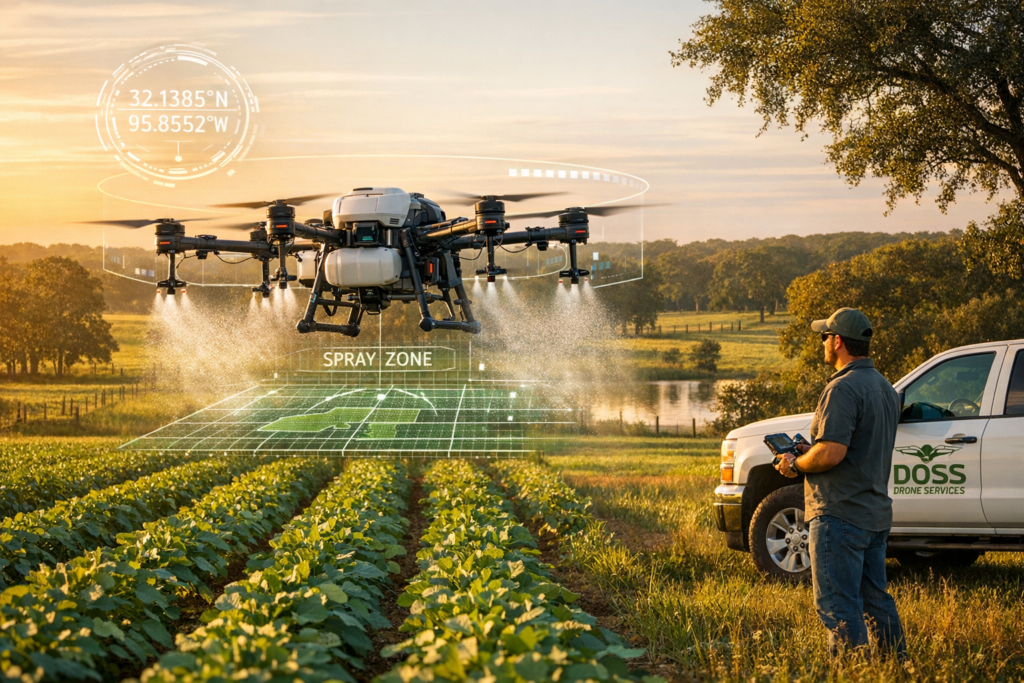
When most people hear the phrase “crop dusting,” they picture a manned aircraft roaring low over a field, trailing a cloud of chemical. That image is increasingly outdated. Today’s high-capacity spray drones, such as the DJI Agras T40 and the DJI Agras T20P, are purpose-built unmanned aerial vehicles that carry between five and ten gallons of liquid per sortie, spray with centrifugal or pressure nozzles calibrated for specific droplet sizes, and navigate autonomously using RTK GPS with centimeter-level accuracy.
Here is what a typical drone spray system includes:
– A multi-rotor UAV airframe rated for agricultural payloads
– Onboard tanks for herbicide, pesticide, fungicide, or liquid fertilizer
– Precision nozzles engineered for drift reduction and droplet size control
– Flight-planning software that allows variable rate application based on field maps
– Obstacle-avoidance sensors and terrain-following radar for safe low-altitude flying
Our fleet at Doss Drone Services aerial application relies on the DJI Agras T40 platform, which gives us up to a 40-pound payload, a swath width of roughly 23 feet, and the ability to cover between 40 and 50 acres per hour under ideal conditions. Compared to traditional ground rigs, which can compact wet soil and struggle in rough terrain, or manned aircraft, which require nearby airstrips and carry higher hourly operating costs, these UAS platforms hit a sweet spot of efficiency and precision agriculture capability.
Precision Agriculture Meets Unmanned Aviation
What truly sets crop spraying drones apart is their integration with precision agriculture workflows. Before we ever load a tank mix, we can use drone mapping and field scouting flights to build high-resolution orthomosaic maps and normalized difference vegetation index imagery of a client’s property. Those maps reveal exactly where weed pressure is heaviest, where nutrient deficiencies are developing, and where fungal issues may be emerging in row crops like corn or soybeans.
Armed with that data, we build prescription maps that tell the drone spray system to increase or decrease its output as it crosses different zones within the same field. This variable rate application approach means you are not blanketing healthy areas with the same pesticide or herbicide rate you apply to trouble spots. You save money on inputs. You reduce environmental load. And you get better results because every ounce of product goes exactly where it is needed. That is the core promise of precision agriculture drones, and it is a promise we deliver on every single day in Athens TX and the surrounding counties.
The evolution from blanket spraying to targeted spraying and spot spraying represents one of the most significant leaps forward in crop protection economics this century. Instead of hiring a manned aircraft to dust an entire 500-acre ranch at a flat rate, a landowner can now engage a custom drone spraying service like ours to treat only the 120 acres where mesquite regrowth or broadleaf weeds are actually present. The return on investment on that decision is immediate and measurable, and we will explore those numbers in more detail below.
Practical Applications: From Weed Control to Seed Broadcasting
Weed and Brush Control in Pastures
If you own grazing land anywhere in East Texas, you already know the annual battle against invasive brush, prickly pear, and broadleaf weeds that steal nutrients from desirable forage grasses. Weed and brush control in pastures is one of the most requested services we provide at Doss Drone Services. Our agricultural drone spraying approach allows us to fly precisely over fence lines, around stock ponds, and along creek buffers that traditional ground rigs simply cannot reach safely.
We commonly apply selective herbicide formulations for drone herbicide application on improved and native pastures. Typical herbicide and pesticide rates are calibrated based on product label requirements, pasture species, and the size and density of target brush. Because our nozzles produce optimized droplet sizes, we achieve excellent coverage patterns with minimal drift, protecting neighboring crops, gardens, and waterways.
Common pasture spraying scenarios we handle include:
– Spring broadleaf weed control in bermudagrass and bahiagrass
– Summer brush management targeting mesquite, huisache, and yaupon
– Fall burndown applications to prepare pastures for overseeding
– Spot spraying isolated patches of thistles, horsenettle, or ragweed
Every one of those jobs benefits from the low-altitude, low-speed flight profile of a UAV pesticide application platform. We can slow the aircraft down to walking speed over a dense brush cluster, ensuring thorough coverage, and then accelerate across open grass where no treatment is needed. That level of control is simply impossible with a manned crop duster traveling at 120 miles per hour.
Row Crop Protection: Pesticides, Fungicides, and Foliar Nutrition
Athens TX sits in the heart of a region where row crops, hay production, and specialty vegetables all coexist. Our custom drone spraying services extend well beyond pasture work into crop protection for corn, soybeans, grain sorghum, and hay meadows. Applying pesticides at precisely the right time in a crop’s growth cycle can mean the difference between a profitable harvest and a devastating loss.
Fungicide applications are a perfect example. In humid East Texas summers, foliar diseases can explode in hay fields and row crops within days. A fast-response aerial application drone can treat affected areas before the pathogen spreads, often within 24 hours of a scouting report. Try getting a manned aircraft scheduled that quickly during peak spraying season.
Beyond crop protection, fertilizer and seed broadcasting by drone is gaining serious traction. We have successfully broadcast cover crop seed, clover seed for wildlife food plots, and granular fertilizer using spreader attachments on our platforms. The even distribution pattern and GPS-guided flight lines ensure consistent seed-to-soil contact, and the ability to broadcast into standing crops or muddy fields where a tractor would cause compaction makes this a compelling aerial crop dusting alternative.
Regulations, Safety, and What Makes a Legal Drone Spraying Operation
FAA Requirements and Pilot Certification
Operating aerial application drones commercially is not as simple as buying a drone and filling it with herbicide. The Federal Aviation Administration requires every commercial drone pilot to hold at least an FAA Part 107 certified pilots license, which involves passing a rigorous aeronautical knowledge exam covering airspace classification, weather, loading, and regulations. At Doss Drone Services, every remote pilot in command on our team holds a current Part 107 certificate and maintains proficiency through ongoing training.
Beyond Part 107, agricultural aerial application with pesticides falls under additional regulatory layers. Operators must comply with EPA label requirements, state Department of Agriculture rules, and, in many cases, hold a state pesticide applicator license. In Texas, the Texas Department of Agriculture oversees commercial applicator licensing, and we maintain all required credentials. Our remote pilot in command personnel are trained not only in safe UAS flight but also in chemical handling, spill response, and environmental stewardship.
Key compliance points we follow on every job:
– Pre-flight airspace authorization through the FAA’s LAANC system when needed
– Product label adherence for every herbicide, pesticide, and fungicide we apply
– Detailed application records including GPS flight logs, product lot numbers, wind speed, temperature, and humidity
– Notification of neighboring landowners when required by state law
– Drift mitigation through nozzle selection, boom height management, and wind-speed operating limits
Drift Reduction and Environmental Responsibility
One of the most common concerns we hear from landowners considering drone herbicide application is drift. Will the product end up on a neighbor’s organic garden or in a nearby creek? It is a valid concern, and it is one we take extremely seriously.
Drift reduction and droplet size control is built into the DNA of our operation. Our precision agriculture drones fly at altitudes between six and fifteen feet above the canopy, far lower than any manned aircraft. The downwash generated by multiple rotors actually pushes droplets downward into the plant canopy, improving penetration and dramatically reducing the chance of lateral drift. We select nozzle tips that produce medium to coarse droplets depending on the product and conditions, and we will not fly when wind speeds exceed label thresholds.
Compared to traditional ground rigs and manned aircraft, drone-based UAV pesticide application puts the operator in a position of extraordinary control. We can see the spray pattern in real time, monitor wind shifts via onboard sensors, and abort a pass in seconds if conditions change. That responsiveness is a major reason precision agriculture drones are gaining regulatory favor around the world.
Real-World Results and the Economics of Custom Drone Spraying Services
Yield Improvement and Input Cost Savings
Numbers matter. We would not ask anyone to adopt new technology based on promises alone, so here is what we consistently observe across our projects in Athens TX and the broader East Texas region.
– Input savings of 15 to 30 percent on herbicide and pesticide costs through variable rate application and spot spraying, because product goes only where it is needed.
– Water savings of up to 90 percent compared to traditional ground rigs, since our drone spray system typically applies two to four gallons per acre versus 15 to 30 gallons for a boom sprayer.
– Reduced soil compaction and crop damage, since the UAV never touches the ground, protecting yield potential in wet-field scenarios.
– Faster turnaround, allowing time-sensitive applications of fungicides or insecticides to happen within hours rather than days.
Yield improvement and input cost savings compound over multiple seasons. A rancher who invests in targeted weed and brush control in pastures reclaims forage acres that were being consumed by invasive species. A row crop farmer who catches a fungal outbreak early with a rapid aerial application avoids catastrophic yield loss. The return on investment for aerial application drones typically becomes apparent within the first growing season.
Why Doss Drone Services Is the Go-To for Aerial Application Drones in East Texas
We founded Doss Drone Services aerial application with a simple mission: bring the most advanced agricultural drone spraying technology to the landowners and farmers of our home region at a fair price with exceptional service. Operating out of Athens TX, we are positioned to serve Henderson County and surrounding East Texas counties quickly and efficiently.
What sets our custom drone spraying services apart:
– We own and operate high-capacity spray drones with proven reliability, not hobbyist equipment.
– Our FAA Part 107 certified pilots carry state pesticide applicator credentials.
– We offer drone mapping and field scouting as a complement to every spraying contract, so treatments are data-driven.
– We handle everything from tank mix and coverage patterns design to post-application record keeping.
– We treat our clients’ land as if it were our own, because in many cases, they are our neighbors.
Whether you need a one-time drone herbicide application on a neglected pasture or a season-long precision agriculture program for your row crops, Doss Drone Services aerial application has the expertise, the equipment, and the local knowledge to deliver measurable results.
Taking the Next Step Toward Smarter Spraying
The era of aerial application drones in East Texas is here, and it is only accelerating. Advances in battery technology, AI-driven flight planning, and regulatory clarity are making agricultural drone spraying more accessible and more cost-effective with every passing season. Farmers and ranchers who embrace precision agriculture now position themselves to reduce costs, protect the environment, and improve yields for years to come.
At Doss Drone Services, we are passionate about helping our neighbors in Athens TX and across East Texas harness this technology. We believe that every acre deserves the attention that only targeted spraying from the air can provide, and we back that belief with professional-grade equipment, certified pilots, and a commitment to results.
If you are ready to see what aerial application drones can do for your operation, whether it is pasture weed control, crop spraying drones for your fields, fertilizer and seed broadcasting by drone, or a comprehensive drone mapping and field scouting assessment, we would love to hear from you. Reach out to us today at dossdronetx.com to schedule a consultation, request a quote, or simply ask questions. We are here to help you farm smarter, spray better, and grow more.