The Unmatched Power of Fixed-Wing Crop Dusters in Modern Agriculture
When most people hear the phrase “crop duster,” they picture a biplane swooping low over golden wheat fields somewhere in the Midwest. While that image is a bit dated, the reality is that fixed-wing crop dusters remain one of the most powerful tools in modern farming. Here in Tyler, TX, we see this firsthand every growing season. Our team at Doss Drone Services operates drone spraying services across East Texas, and we are passionate advocates for unmanned aerial application. But we also believe in honesty. The truth is, there are farms and scenarios where agricultural aircraft simply outperform drones, and pretending otherwise would be a disservice to the growers we serve. In this article, we break down exactly why manned aerial application still dominates certain operations, where drones shine brightest, and how the two technologies can work together to give East Texas agriculture the best of both worlds.
A Brief History of Aerial Spraying and Why Fixed-Wing Crop Dusters Endure
Aerial application has been a cornerstone of American agriculture for over a century. The first recorded crop dusting operations took place in the 1920s, when a former military pilot loaded lead arsenate dust into a modified Curtiss JN-4 biplane and flew over a catalpa grove in Ohio to combat sphinx moth larvae. That single flight launched an entire industry. By the mid-twentieth century, agricultural airplanes were a common sight over broadacre crops like corn, cotton, wheat, and soybeans from the Mississippi Delta to the Texas Panhandle.
How Tyler, TX Became a Hub for Ag Aviation
Tyler, TX, and the broader East Texas region may be better known for roses and pine timber, but row-crop agriculture and cattle pasture operations have sustained communities here for generations. East Texas crop spraying has historically relied on fixed-wing crop dusters operating out of small rural airstrips scattered between Longview, Nacogdoches, and Palestine. Agricultural pilots in our area know every tree line, every power line, and every creek bottom by heart. That intimate knowledge of local terrain, combined with the raw capability of a purpose-built ag aircraft, is something no algorithm can fully replicate.
The modern ag aviation industry is regulated under FAA Part 137 agricultural operations, a certification pathway that ensures every aerial applicator meets rigorous standards for pilot proficiency, aircraft maintenance, and chemical handling. Certified aerial applicators operating under Part 137 must demonstrate competence in areas like spray drift control, emergency procedures, and environmental compliance. These regulations exist because manned agricultural aircraft carry hundreds of gallons of product and fly at speeds and altitudes that demand serious expertise.
The Machines That Define Modern Crop Dusting Operations
Today’s agricultural airplanes are engineering marvels. The two dominant manufacturers in the sector are Air Tractor, headquartered right here in Texas in Olney, and Thrush Aircraft based in Albany, Georgia. An Air Tractor AT-802, for example, can carry up to 800 gallons of liquid product, cruise at 140 knots, and cover a swath width of 60 to 80 feet in a single pass. Thrush aircraft offer similarly impressive payload and performance figures. These are not your grandfather’s biplanes. They are turbine-powered, GPS-guided workhorses designed from the ground up for aerial application.
The boom length and nozzle configuration on a modern ag plane can be precisely tuned for every job. Operators select nozzle types, orientations, and pressures to produce specific droplet sizes, which is critical for spray drift control and ensuring the right application rates and coverage. Combined with GPS-guided flight systems, today’s agricultural aircraft can fly perfectly parallel flight lines with sub-meter accuracy, eliminating skips and overlaps that waste product and money.
We respect these machines because we understand them. When a grower in East Texas needs 1,000 acres of cotton treated with a fungicide application before a rain event hits in 36 hours, there is simply no substitute for a turbine Air Tractor or Thrush aircraft thundering down the field at 150 miles per hour. That brings us to the core question: why do fixed-wing crop dusters still beat drones on some farms?
Where Fixed-Wing Crop Dusters Outperform Drone Spraying Services
We operate drone spraying services, so we know the capabilities and limitations of both platforms intimately. There are four major areas where manned agricultural aircraft hold a decisive advantage, and we want every grower in Tyler, TX, and the surrounding East Texas region to understand them clearly.
Speed, Payload, and Sheer Acreage Coverage
The single biggest advantage of fixed-wing crop dusters is throughput. A loaded Air Tractor can treat 1,000 acres or more in a single day depending on field configuration and turnaround logistics. Compare that to a typical agricultural spraying drone, which carries between 2.5 and 10 gallons per flight and covers roughly 15 to 30 acres per hour under ideal conditions. When you do the math on broadacre crops like corn, cotton, soybeans, or wheat, the manned plane wins overwhelmingly on large, open fields.
Here is a practical comparison:
– A fixed-wing ag plane carrying 500 gallons with an 80-foot swath width can cover about 100 acres per load in roughly 15 to 20 minutes of flight time.
– A large spraying drone carrying 10 gallons with a 20-foot swath width needs approximately 50 to 70 flights and multiple battery swaps to cover those same 100 acres.
– Total time for the drone operation on 100 acres can exceed 6 to 8 hours, while the manned plane finishes in under 2 hours including ferry and reload time.
For growers managing thousands of acres of broadacre crops, the economics tilt heavily toward aerial application by manned aircraft. Time sensitivity matters enormously in pesticide application and herbicide application. When bollworms are devouring cotton or fungal pressure is building on soybeans before harvest, every hour of delay costs real money. Agricultural pilots understand this urgency, and their machines are built for it.
Precision Agriculture Technology in Manned Aircraft
A common misconception is that drones are inherently more precise than planes. In reality, modern ag aviation technology has closed this gap dramatically. Today’s fixed-wing crop dusters are equipped with sophisticated GPS guidance systems, variable rate application controllers, flow control valves, and real-time mapping software that rivals anything available on drone platforms.
Precision application on a manned aircraft starts with GPS-guided flight lines. The pilot sees a guidance display in the cockpit that shows exactly where previous passes were made, ensuring consistent swath width coverage with no gaps. Advanced systems allow variable rate application, meaning the aircraft can automatically adjust the flow of herbicide application, fungicide application, or fertilizer application based on prescription maps generated from satellite imagery or soil sampling data.
Boom length and nozzle configuration further enhance precision agriculture capabilities. Operators can choose from dozens of nozzle types, including air induction nozzles that produce coarser droplets for spray drift control, or flat-fan nozzles that produce finer droplets for better canopy penetration during pesticide application. The ability to fine-tune droplet spectrum is essential for drift mitigation, particularly near sensitive areas like residential zones, organic fields, or waterways.
We have seen firsthand in East Texas crop spraying operations how a skilled agricultural pilot equipped with modern ag aviation technology can deliver application rates and coverage that meet or exceed label requirements with remarkable consistency across thousands of acres.
Where Drones Win and How They Complement Manned Aircraft
Now, here is where we get excited, because this is our core business. We launched Doss Drone Services in Tyler, TX, because we saw a genuine gap in the market. Not every farm in East Texas is a 5,000-acre cotton operation with a private airstrip. Many of the growers we serve have small fields, irregular terrain, waterways, tree lines, and obstacles that make conventional aerial spraying by manned aircraft impractical, unsafe, or cost-prohibitive.
Small Fields and Irregular Terrain Are Drone Territory
Drone spraying services excel in situations that would give even the most experienced ag pilots pause. Consider these scenarios common across East Texas agriculture:
– A 15-acre hay meadow surrounded by pine timber on three sides with power lines along the fourth.
– A 40-acre pecan orchard with mature trees that need targeted fungicide application below the canopy.
– A 10-acre specialty vegetable plot adjacent to an organic neighbor who cannot tolerate any spray drift.
– Irregularly shaped pastures carved out of creek bottoms and rolling terrain near Tyler, TX.
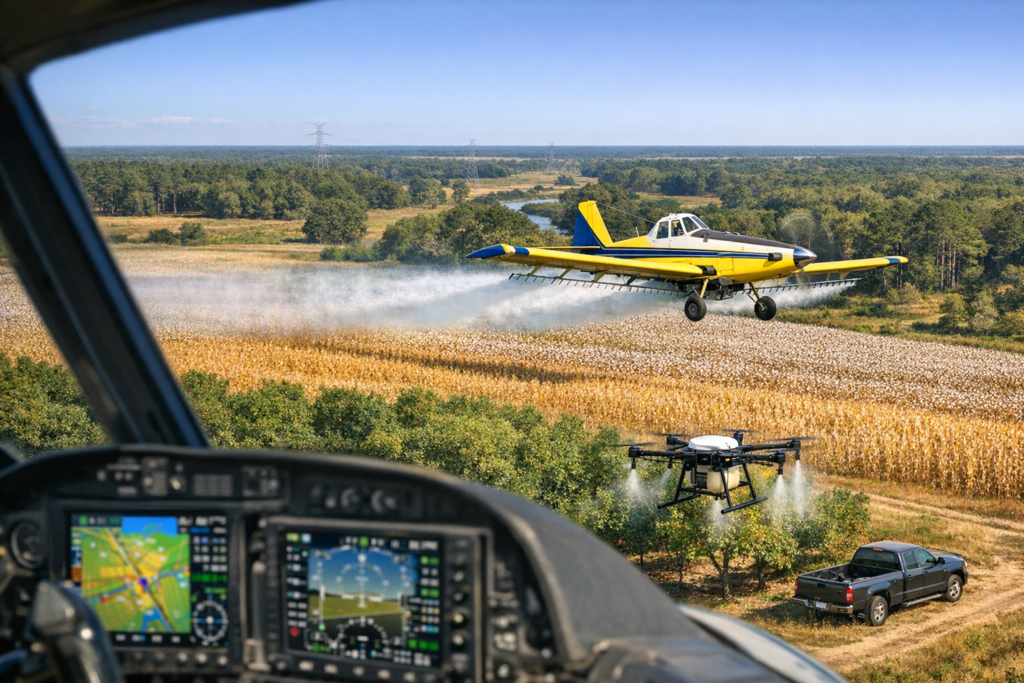
In each of these cases, unmanned aerial application offers advantages that no fixed-wing crop duster can match. Our drones fly slower, lower, and with far greater maneuverability. We can stop on a dime, turn on a point, and treat odd-shaped parcels with virtually zero wasted product. The downwash from our rotors pushes droplets down into the canopy, which improves deposition on target surfaces during pesticide application and herbicide application alike.
For small fields and irregular terrain, the cost-per-acre equation often favors drone spraying services. Mobilizing a manned agricultural aircraft for a 15-acre field rarely makes economic sense. The ferry flight, loading, and setup costs are the same whether the job is 15 acres or 1,500 acres. Our drones, by contrast, deploy from a truck bed and can be airborne in minutes.
Complementing Manned Aircraft for Complete Farm Solutions
The smartest growers we work with in East Texas agriculture do not see fixed-wing vs drone spraying as an either-or proposition. They see it as a both-and strategy. On a typical diversified farming operation near Tyler, TX, a grower might use a manned ag plane for the big broadacre crops like corn and soybeans, then call us for drone spraying services on the smaller, harder-to-reach parcels, fence lines, waterways, and specialty plots.
This approach of complementing manned aircraft with drone technology maximizes efficiency across the entire operation. The fixed-wing crop dusters handle the heavy lifting on open ground, delivering unmatched speed and payload. Our drones handle the detailed work in tight spaces where precision application is paramount and safety margins for manned flight are thin.
We have also seen growing demand for drone-based scouting and mapping that feeds directly into the precision agriculture systems on manned aircraft. We fly mapping missions that generate NDVI imagery, identifying trouble spots in a field. That data then becomes the prescription map loaded into the Air Tractor or Thrush aircraft GPS guidance system for a variable rate fertilizer application or targeted herbicide application pass. The two platforms work in tandem, and the farmer gets better results than either platform could deliver alone.
Choosing the Right Aerial Application Strategy for Your East Texas Farm
So how do you decide when to call a manned aerial applicator and when to call us for drone spraying services? The answer depends on several practical factors that we help our clients evaluate every season.
Key Decision Factors for Growers
Here are the primary considerations we walk through with every farmer who contacts us:
– Field size: If you are treating 200 or more contiguous acres of open broadacre crops, a fixed-wing crop duster operating under FAA Part 137 agricultural operations certification will almost certainly be faster and more cost-effective. Under 50 acres, drones usually win on both cost and precision.
– Field shape and obstacles: Irregular terrain, tree lines, buildings, power lines, and neighboring sensitive crops all favor unmanned aerial application. Ag pilots are skilled, but physics and wingspan impose hard limits on how close a manned agricultural airplane can safely operate near obstacles.
– Product type and application requirements: Some pesticide application and herbicide application labels specify maximum droplet sizes, buffer zones, or application rates and coverage standards that may favor one platform over the other. We always review the product label with our clients.
– Turnaround time: When you need 2,000 acres treated before tomorrow’s rain, call the ag plane. When you need a precise 20-acre fungicide application on high-value specialty crops, call us.
– Budget: Mobilization costs for manned agricultural aircraft can be high for small jobs. Drone spraying services typically offer more flexible pricing for smaller acreages.
– Regulatory environment: Both manned and unmanned operations must comply with federal and state regulations. Certified aerial applicators flying under FAA Part 137 have different operational rules than drone operators flying under Part 107 with agricultural waivers. We ensure full compliance on every job.
The Future of Fixed-Wing vs Drone Spraying
The aerial application industry is evolving rapidly. Ag aviation technology continues to advance on both manned and unmanned platforms. We are seeing larger drones with greater payload capacity, longer battery life, and more sophisticated precision application systems entering the market every year. At the same time, manned agricultural aircraft manufacturers like Air Tractor and Thrush continue to refine their platforms with better engines, improved cockpit technology, and enhanced spray drift control systems.
Our honest assessment is that fixed-wing crop dusters will remain dominant on large-scale broadacre operations for at least the next decade, possibly longer. The energy density of jet fuel versus lithium batteries creates a fundamental payload and endurance advantage that current drone technology cannot overcome on big acreage. But the crossover point, the field size where drones become competitive with manned aircraft, is dropping every year as drone technology improves.
In East Texas agriculture, where farm sizes vary wildly and terrain can be challenging, both platforms have a bright future. The winners will be the growers who strategically deploy both tools, using agricultural airplanes for scale and speed, and drone spraying services for precision, flexibility, and access to difficult terrain.
Partner With Us for Smarter Aerial Application in Tyler, TX
We built Doss Drone Services on a foundation of respect for the agricultural traditions that sustain our East Texas communities, and a passion for the new technology that can make farming more efficient, more precise, and more sustainable. We are not here to replace fixed-wing crop dusters. We are here to fill the gaps they cannot reach and to complement manned aircraft with capabilities that simply did not exist a decade ago.
Whether you farm 20 acres of specialty vegetables or manage thousands of acres of cotton and corn, we want to help you build an aerial application strategy that makes sense for your land, your crops, your budget, and your timeline. Our team understands crop dusting operations from both sides of the equation, and we are committed to giving you honest, practical advice, even when that advice is to call a manned ag plane instead of us.
If you are ready to explore how drone spraying services can fit into your operation, or if you just want to talk through the fixed-wing vs drone spraying decision for your specific fields near Tyler, TX, we would love to hear from you. Reach out to us today at dossdronetx.com and let us help you get the most out of every acre.